Preferred Choice Restoration
Quality-focused restoration company specializing in mold remediation, water damage, and insurance claim assistance for residential properties.
Services Fort McDowell and the surrounding area
Compare ratings, reviews, and services from the best mold remediation contractors serving Fort McDowell and the surrounding area — then get matched with a free, no-obligation quote.
 Comparing top-rated mold removal companies serving Fort McDowell, Arizona
Fort McDowell sits along the lower Verde River, and that river is the single biggest difference between mold risk here and mold risk in the rest of the Phoenix metro. Riparian corridors hold more ambient humidity than open desert, ground moisture near the river runs higher, and properties within the floodplain face a genuine riverine flooding risk on top of the usual monsoon runoff — a combination that gives mold far more to work with than a dry Scottsdale lot.
Arizona Mold Pros compared the mold remediation contractors serving the Fort McDowell area on ratings, emergency response, and range of services, since not every valley company travels out along the Beeline. Whether you need post-flood water damage restoration, mold inspection and testing, or full mold remediation, compare your options below before you commit.
Last Updated: September 2026
The companies below serve the Fort McDowell area. We do not rank them, rate them, or verify their credentials on your behalf — that check is yours to make, and the steps below are the ones worth making it with. Arizona issues no mold-specific license, so the burden of confirming a contractor's licensing, insurance, and scope of work sits with the homeowner.
Arizona issues no mold-specific license, so crews work under a Registrar of Contractors license. Ask for the number and look it up — status, classification, and complaint history are all public.
Request a certificate of liability insurance naming you, sent directly from the insurer or agent rather than a copy from the contractor.
A written scope should name the moisture source, the containment method, what gets removed versus dried, and how completion will be confirmed.
Prices for the same job vary widely. Three written quotes tell you whether an outlier is thorough or simply expensive.
Remediation before the leak is repaired means paying for the same work twice. Any quote silent on the source is incomplete.
For anything past a small area, have post-remediation verification done by someone other than the company that did the removal in Fort McDowell.
Quality-focused restoration company specializing in mold remediation, water damage, and insurance claim assistance for residential properties.
Professional mold remediation company using advanced moisture detection to eliminate mold and prevent recurrence. Serves Phoenix, Mesa, Chandler, Gilbert, and beyond.
Arizona's leading mold and water damage restoration company specializing in emergency response, mold inspection, and full property restoration.
Mold specialists handling emergency mold removal and remediation with itemized scopes of work.
Mold damage restoration specialists offering inspection, containment, removal, and repairs.
| Service | Average Cost Range |
|---|---|
| Mold Inspection | $300 – $600 |
| Small Area Remediation (under 50 sq ft) | $1,500 – $3,500 |
| Medium Remediation (50–200 sq ft) | $3,500 – $6,000 |
| Full Home Remediation (200+ sq ft) | $5,000 – $10,000 |
| Attic Mold Removal | $2,000 – $6,000 |
| Crawl Space Mold Removal | $2,500 – $7,000 |
| Black Mold Removal | $3,000 – $8,000 |
| Commercial Mold Remediation | $5,000 – $25,000+ |
Costs in Fort McDowell can vary depending on the size of the affected area, type of mold, accessibility, and whether structural repairs are needed. Arizona's dry climate means mold often concentrates around specific moisture sources — monsoon water intrusion, swamp cooler leaks, or plumbing failures — rather than spreading across entire homes. We recommend getting at least 3 quotes from licensed contractors to compare pricing.
Get free quotes from top Fort McDowell mold removal companiesProximity to the Verde River shapes everything. Flowing water and riparian vegetation keep local humidity higher than surrounding desert averages, which means damp materials dry more slowly and condensation forms more readily on cool surfaces. Properties in the floodplain also carry real flood exposure — the lower Verde has a documented history of significant flood events, and floodwater does not simply wet a structure, it drives silt and organic material into wall cavities and under flooring where it becomes food for mold.
Groundwater near the river tends to sit higher too, which matters for anything below grade or in contact with soil. After any flooding the 24-to-48-hour window is decisive: getting a structure genuinely dry, not just visibly dry, is the difference between a cleanup and a full remediation. That is the core of professional water damage restoration.
The local housing mix adds a second dimension. Alongside conventional construction, the area includes older homes and manufactured and mobile homes, and those have distinct moisture weak points: skirted underfloor spaces with limited ventilation, belly-wrap insulation that traps water once it is breached, roof-to-wall seams that open up over time, and ductwork run beneath the floor where it can sweat or fill after a flood.
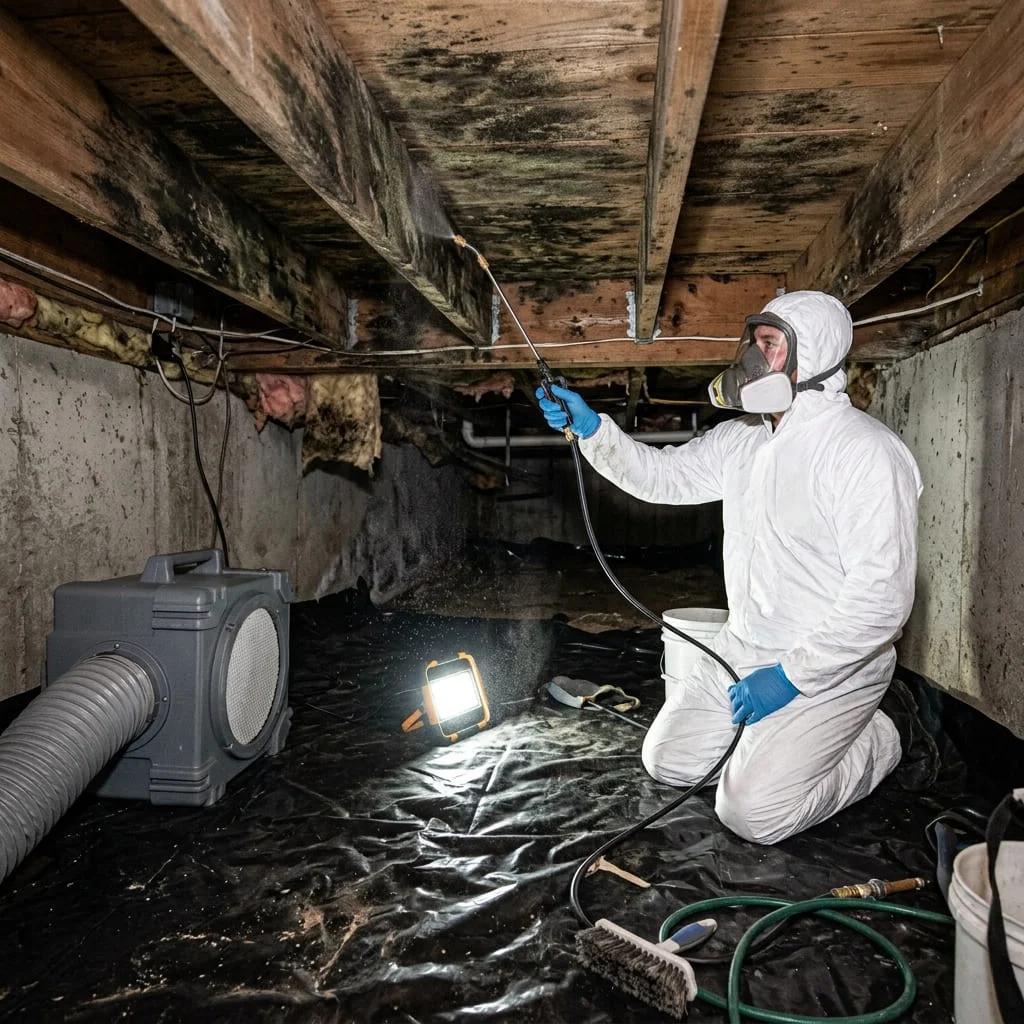
An underfloor space beneath a manufactured home is one of the easiest places in Arizona for mold to establish unnoticed, because it is dark, poorly ventilated, and rarely inspected. Where evaporative coolers are in use, add summer-long humid air being pushed through the house and condensation collecting around ducts and ceiling penetrations. Both scenarios commonly call for crawl space mold removal or attic mold removal.
Inside, the warning signs follow the same pattern as anywhere but escalate faster in this humidity: soft or spongy flooring, staining low on walls, peeling vinyl or lifting laminate, and a musty smell that gets stronger near the floor or in a closet on an exterior wall. Ceiling stains after a storm point to roof or seam failure; floor-level symptoms point to underfloor moisture or past water intrusion.
If your property took water at any point — flood, monsoon runoff, or plumbing failure — and it was dried by opening the doors and waiting, it is worth having a professional look even if nothing is visible. Mold that established after an incomplete dry-out is usually inside the assembly rather than on its surface, which is why black mold removal so often begins with moisture mapping rather than demolition.
Fort McDowell is the community of the Fort McDowell Yavapai Nation, and work on tribal land can involve requirements that differ from those in unincorporated Maricopa County or an incorporated city. Permitting, authorization, and contractor approval may run through tribal processes rather than county ones, so the practical step is to confirm with the relevant tribal authority what is required for your property before work begins, and to ask any contractor directly whether they have done remediation within the Nation before. A crew that has will already know the process; one that has not may cause delays partway through a job.
Second, confirm travel and response time honestly. Fort McDowell is out along the Beeline Highway corridor, and some valley companies that list it in a service area will still take hours to arrive — which matters a great deal when the clock on a wet structure is 24 to 48 hours. Ask for a realistic on-site time for an emergency call, not just whether they cover the area.
Third, if flooding or river-related water was involved, ask specifically how they handle it. Floodwater carries silt and organic material into assemblies and is treated as contaminated, which changes the protocols, the protective equipment, and often what materials can be salvaged versus what has to be removed. Get that written into the scope. Arizona Mold Pros can connect you with a specialist covering the area — nearby you can also compare mold removal companies in Fountain Hills and Rio Verde, or view all service areas.
Soft or spongy flooring, or a musty smell that's strongest near the floor, is worth taking seriously in a manufactured or mobile home here — it usually points to moisture in the underfloor or belly-wrap space, which is dark, poorly ventilated, and easy to miss during a normal walk-through.
Staining or peeling low on a wall that reappears after each rain, even with no single leak anyone can point to, is a sign of elevated ambient humidity from the Verde River corridor rather than a one-time event — the wall is drying more slowly than it would elsewhere in the metro, not necessarily failing structurally.
Any silt line, debris, or lingering dampness after a flood event is worth having checked even when the structure looks dry on the surface — floodwater drives silt and organic material into cavities that stay wet long after the visible water is gone. Contact a licensed mold remediation professional for an inspection rather than assuming a dried surface means the structure dried too.
Confirm with the relevant tribal authority what's required for your property before work begins — permitting and contractor approval on Fort McDowell Yavapai Nation land can run through tribal processes rather than county ones, and settling that upfront avoids delays partway through a job.
If floodwater from the Verde was involved, expect it to be treated as contaminated water rather than clean water — meaning more affected material gets removed rather than dried in place — and the contractor should say so plainly before writing the scope.
For a manufactured or mobile home, expect the inspection to include the underfloor or belly-wrap space specifically, not just the interior finishes, since that's where this housing type's moisture problems typically start.
Mold remediation is one of the few home services where the homeowner carries most of the verification burden. These four checks apply to every contractor on this page, and they are worth running before you sign anything.
Arizona does not issue a license specifically for mold remediation. Crews generally work under an Arizona Registrar of Contractors (ROC) license instead, which means verifying a contractor's ROC status and insurance is on the homeowner rather than on the state.
Check a license at the Arizona ROC →EPA guidance suggests that mold covering roughly more than 10 square feet is generally beyond a do-it-yourself cleanup and warrants professional remediation. Smaller patches can often be handled yourself — provided you have also fixed the moisture source feeding them.
EPA mold cleanup guidance →The ANSI/IICRC S520 standard is the widely recognized standard of care for professional mold remediation, covering containment, worker protection, and verification. A contractor who can tell you how their scope maps to it is giving you something you can hold them to.
Post-remediation verification confirms the work succeeded. Where the budget allows, have it performed by someone independent of the company that did the removal, so the party certifying the result is not the party being paid for it.
How this guide works. Arizona Mold Pros is a directory — we are not the remediation contractor and we do not perform the work ourselves. Listings are compiled from publicly available information about companies advertising mold services in the Fort McDowell area, and ratings and review counts are approximate figures gathered from public sources that change over time, so verify them yourself before hiring. We may be compensated when a homeowner connects with a contractor through this site. That does not change the evaluation criteria above, and we recommend comparing at least three written scopes regardless of who you call.
Contractors do work in the community, but requirements on tribal land can differ from county or city processes — permitting, authorization, and contractor approval may run through tribal rather than Maricopa County channels. Confirm what is required for your property with the relevant tribal authority before work starts, and ask any contractor whether they have completed remediation within the Nation previously.
Yes. Riparian corridors hold more ambient humidity than open desert, so damp materials dry more slowly and condensation forms more readily on cool surfaces. Groundwater near the river also sits higher, and properties in the floodplain carry genuine flood exposure. Floodwater is worse than clean water because it drives silt and organic material into wall cavities where it feeds mold growth.
The weak points differ from conventional construction. Skirted underfloor spaces have limited ventilation, belly-wrap insulation traps water once breached, roof-to-wall seams open over time, and underfloor ductwork can sweat or fill after flooding. An underfloor space is one of the easiest places for mold to establish unnoticed, so any inspection should include it rather than stopping at the interior finishes.
Cost can run higher than a typical Valley job if floodwater was involved, since contaminated material generally has to be removed rather than dried — get the water category (clean versus contaminated) confirmed before comparing quotes, because it changes the number significantly.
Confirm a realistic arrival time given the distance out the Beeline Highway corridor — some companies that list the area still take hours to reach it, which matters given the 24-to-48-hour window that determines whether a wet structure can be dried rather than remediated.
If the damage came from river flooding, check whether you carry separate flood insurance — a standard homeowners policy typically excludes damage from rising flood water regardless of cause, and flood coverage in the US is generally a distinct policy. Damage from an ordinary plumbing failure is evaluated the way it would be anywhere else.
It shows up more readily here than in drier parts of the metro because of the Verde River corridor's higher ambient humidity, and it's a particular risk in the underfloor space of a manufactured or mobile home, or in any structure where floodwater carried silt and organic material into wall cavities.
If floodwater was involved and is being treated as contaminated, temporary relocation is more likely to be recommended during the more aggressive containment and removal process — similar to how a sewage-contamination job is handled elsewhere. For a smaller, clean-water job, most households stay home.
On a manufactured or mobile home, check the underfloor and belly-wrap space periodically rather than only the interior. Keep drainage and gutters clear given the area's higher regional humidity, and confirm your flood insurance status given the property's proximity to the Verde River floodplain.
Don't wait for mold to spread. Compare the top-rated mold removal contractors serving Fort McDowell and the surrounding area. Get your free estimate today — no obligation, no pressure.
Call Now for Free QuotesFree estimates · No obligation · Licensed contractors