Thomas Restoration
Professional mold remediation company using advanced moisture detection to eliminate mold and prevent recurrence. Serves Phoenix, Mesa, Chandler, Gilbert, and beyond.
Compare ratings, reviews, and services from the best mold remediation contractors serving Paradise Valley and the surrounding area — then get matched with a free, no-obligation quote.
Comparing top-rated mold removal companies serving Paradise Valley, ArizonaParadise Valley properties have more ways to get wet than an ordinary house does. Estate lots carry pools, water features, misting systems, and dense irrigation running close to foundations. The mid-century homes along the Camelback and Mummy Mountain corridors bring flat roofs with parapets and, in many cases, original plumbing. And the sheer scale of a multi-wing floor plan with guest casitas means whole sections of a home can go weeks without anyone opening a door.
Arizona Mold Pros compared the mold remediation contractors working in Paradise Valley on ratings, service range, response time, and whether they can handle inspection, containment, removal, and the reconstruction of high-end finishes. If you have found staining, a musty smell in an unused wing, or ponding on a flat roof after a monsoon, start with mold inspection and testing and compare the companies below.
Last Updated: July 2026
Every company listed below is evaluated on customer reviews, Google ratings, licensing and insurance status, response time and availability, the range of mold services offered, and experience with Arizona-specific mold issues like monsoon moisture and swamp cooler condensation. We only feature companies that actively serve the Paradise Valley area.
Verified Google ratings and the volume and consistency of homeowner reviews.
Companies that carry the licensing and insurance Arizona homeowners should expect.
How quickly a company can be on site — including 24/7 emergency coverage.
Inspection, testing, remediation, and water damage restoration under one roof.
Familiarity with monsoon moisture, swamp cooler condensation, and desert construction.
Only companies that actively serve the Paradise Valley area make our list.
Professional mold remediation company using advanced moisture detection to eliminate mold and prevent recurrence. Serves Phoenix, Mesa, Chandler, Gilbert, and beyond.
IICRC certified mold remediation specialists with over 9,000 five-star reviews. Experts in containment, removal, and prevention of mold growth.
National franchise with local Arizona teams providing 24/7 emergency mold removal and water damage restoration with same-day service.
Arizona's leading mold and water damage restoration company specializing in emergency response, mold inspection, and full property restoration.
Licensed general contractor offering mold removal, testing, water damage restoration, and full reconstruction. One-stop-shop from detection to rebuild.
| Service | Average Cost Range |
|---|---|
| Mold Inspection | $300 – $600 |
| Small Area Remediation (under 50 sq ft) | $1,500 – $3,500 |
| Medium Remediation (50–200 sq ft) | $3,500 – $6,000 |
| Full Home Remediation (200+ sq ft) | $5,000 – $10,000 |
| Attic Mold Removal | $2,000 – $6,000 |
| Crawl Space Mold Removal | $2,500 – $7,000 |
| Black Mold Removal | $3,000 – $8,000 |
| Commercial Mold Remediation | $5,000 – $25,000+ |
Costs in Paradise Valley can vary depending on the size of the affected area, type of mold, accessibility, and whether structural repairs are needed. Arizona's dry climate means mold often concentrates around specific moisture sources — monsoon water intrusion, swamp cooler leaks, or plumbing failures — rather than spreading across entire homes. We recommend getting at least 3 quotes from licensed contractors to compare pricing.
Compare free quotes from top Paradise Valley mold removal companiesFlat roofs are the signature Paradise Valley risk. The mid-century modern homes the town is known for were designed with low-slope roofs and parapet walls, and those assemblies drain through scuppers and internal drains rather than shedding water over an eave. When a scupper clogs with debris or a membrane seam opens, monsoon rain ponds instead of running off, and standing water finds the weakness at a parapet base or a penetration curb.
Water that gets past the membrane then travels along the roof deck, often emerging on a ceiling well away from the entry point. On homes re-roofed over original substrate, moisture can sit between layers for a long time before it shows at all. Ceiling staining after a storm on a flat-roofed home should be treated as a roofing and attic mold investigation, not a paint problem.
The second cluster of risk is water you installed on purpose. Pools, spas, fountains and other water features, patio misting systems, and the irrigation needed to keep mature desert landscaping alive all put a great deal of moisture close to the structure. Irrigation lines running near a foundation are a routine source of hidden moisture, because a broken emitter or a cracked lateral can run on a timer for months without any visible surface clue.
Pool equipment areas, outdoor kitchens, and pool bathrooms are the interior rooms most often affected — they combine plumbing, limited ventilation, and walls shared with wet exterior areas. Mid-century homes with original cast iron or galvanized supply and drain lines add another layer, since those materials tend to fail by seeping at joints rather than bursting. A slow drain leak inside a wall is exactly the scenario that leads to black mold removal months later.
Scale is the third factor, and it is the one that turns a small problem into a large one. A Paradise Valley estate may have guest casitas, a wine room, a pool house, and multiple wings — and the rooms with the highest mold risk are precisely the ones nobody visits daily. Humidity-controlled spaces like wine rooms are a special case, because they are deliberately kept at a higher relative humidity than the rest of the house and depend on their vapor barrier and cooling unit performing exactly as designed.
Unoccupied casitas with the cooling turned down, guest bathrooms whose traps dry out, and closed-off wings all allow moisture to accumulate unobserved. If a wing or casita has been shut for a season, treat a musty smell as a reason to book an inspection rather than to air it out, and expect a thorough scope to include water damage restoration wherever moisture has been running for a while.

The mold removal itself is not more expensive in Paradise Valley — putting the house back together is. Remediation means removing porous materials the mold has colonized, and on an estate property those materials are frequently stone, custom millwork, integral-color plaster, specialty tile, or hardwood specified fifteen years ago and no longer stocked. Matching a plaster finish or sourcing a discontinued stone is often a larger line item than the containment and removal combined.
Access and occupancy add to it. Containment on a large, occupied home means building negative-pressure barriers that keep the rest of the residence usable while one wing is worked on, and protecting adjacent finishes that cannot simply be replaced if they are damaged. Where a claim is involved, high-value properties also demand far more documentation — moisture readings, photographic scope, material inventories — because the insurer will scrutinize a large loss closely, and reputable contractors build that documentation time into the estimate.
Two things are worth insisting on at this price point. First, get post-remediation verification from someone independent of the company that did the removal, so the party confirming success is not the party being paid for it. Second, make sure the scope names the moisture source and its correction, not just the affected square footage — a flat roof scupper or an irrigation lateral that never gets fixed will bring the problem straight back. Compare the cost table above against at least three written scopes, and see nearby mold removal companies in Carefree and Fountain Hills if your contractor list is thin. Arizona Mold Pros can help you get matched with specialists covering the Camelback corridor.
The most obvious sign is visible growth — black, green, or white spots spreading across walls and ceilings, under sinks, or around window frames. But mold in Paradise Valley homes often hides, so a persistent musty or earthy odor in a bathroom, closet, or other enclosed space is just as important to take seriously. That smell usually means moisture is feeding something you can't yet see.
Context matters too. If your Paradise Valley home has had recent water damage, flooding, or a plumbing leak, mold can begin growing within 24 to 48 hours. Watch for peeling paint, bubbling wallpaper, or discoloration on surfaces, and pay attention to condensation collecting on windows or walls. Unexplained respiratory symptoms, worsening allergies, or headaches that ease when you leave the house can also point to a hidden mold problem.
If you notice any of these signs in your Paradise Valley home, contact a licensed mold remediation professional for an inspection before the problem spreads.
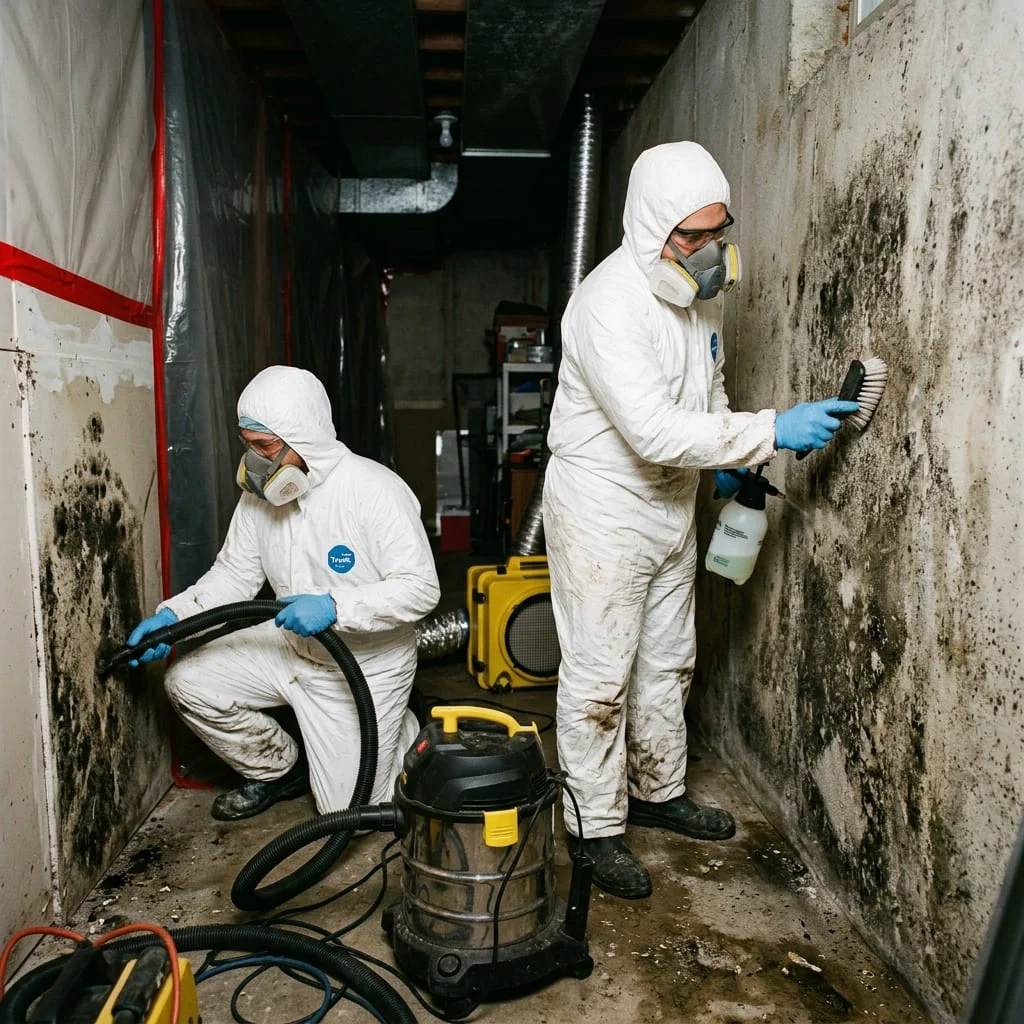
A quality mold removal company in Paradise Valley starts with an inspection and assessment to identify the type of mold and the extent of the problem. Once the scope is clear, the crew contains the affected area with plastic sheeting and negative air pressure so spores don't spread to clean parts of the house, then runs HEPA air filtration to capture anything airborne.
From there, the actual remediation begins: physical removal of mold using antimicrobial treatments and scrubbing, followed by thorough drying and dehumidification of the affected areas. Any damaged materials — drywall, insulation, or flooring — are repaired or replaced, and reputable contractors finish with post-remediation testing to confirm mold levels are back to normal.
The best mold removal companies serving Paradise Valley will provide a detailed scope of work and walk you through each step before starting any remediation.
Mold remediation is one of the few home services where the homeowner carries most of the verification burden. These four checks apply to every contractor on this page, and they are worth running before you sign anything.
Arizona does not issue a license specifically for mold remediation. Crews generally work under an Arizona Registrar of Contractors (ROC) license instead, which means verifying a contractor's ROC status and insurance is on the homeowner rather than on the state.
Check a license at the Arizona ROC →EPA guidance suggests that mold covering roughly more than 10 square feet is generally beyond a do-it-yourself cleanup and warrants professional remediation. Smaller patches can often be handled yourself — provided you have also fixed the moisture source feeding them.
EPA mold cleanup guidance →The ANSI/IICRC S520 standard is the widely recognized standard of care for professional mold remediation, covering containment, worker protection, and verification. A contractor who can tell you how their scope maps to it is giving you something you can hold them to.
Post-remediation verification confirms the work succeeded. Where the budget allows, have it performed by someone independent of the company that did the removal, so the party certifying the result is not the party being paid for it.
How this guide works. Arizona Mold Pros is a directory — we are not the remediation contractor and we do not perform the work ourselves. Listings are compiled from publicly available information about companies advertising mold services in the Paradise Valley area, and ratings and review counts are approximate figures gathered from public sources that change over time, so verify them yourself before hiring. We may be compensated when a homeowner connects with a contractor through this site. That does not change the evaluation criteria above, and we recommend comparing at least three written scopes regardless of who you call.
The removal is comparable; the reconstruction is not. Remediation requires taking out porous materials the mold has colonized, and on estate properties those are often stone, custom millwork, integral-color plaster, or discontinued specialty finishes that are expensive to match or source. Containment on a large occupied home and the heavier documentation required for high-value insurance claims add further cost.
They are one of the most common causes here. Low-slope roofs with parapets drain through scuppers and internal drains, so a clogged scupper or an open membrane seam lets monsoon rain pond rather than run off. Water that gets past the membrane travels along the roof deck and often stains a ceiling far from where it entered, which is why moisture mapping should precede any repair.
Yes, and those spaces are usually the highest priority. Rooms nobody enters daily let moisture accumulate unobserved, cooling is often turned down, and unused bathroom traps dry out. Wine rooms deserve particular attention because they are deliberately held at higher humidity and depend entirely on their vapor barrier and cooling unit working as designed. Get an inspection before airing out a musty space.
Mold removal costs in Paradise Valley typically range from $1,500 for small areas to $10,000 or more for full-home remediation. The exact cost depends on the size of the affected area, type of mold, and whether structural repairs are needed. We recommend getting at least 3 quotes from licensed contractors.
Most residential mold remediation jobs in Paradise Valley take 1 to 5 days. Larger projects involving multiple rooms, extensive water damage, or structural repairs can take up to 2 weeks. Your contractor should provide a timeline before work begins.
It depends on the cause. Arizona homeowners insurance typically covers mold remediation if the mold resulted from a sudden, accidental event like a burst pipe or storm damage. Mold caused by ongoing neglect, deferred maintenance, or pre-existing conditions is usually not covered. Check with your insurance provider for specifics.
Yes. Despite Arizona's dry climate, black mold (Stachybotrys chartarum) can develop anywhere with persistent moisture — bathrooms, attics, crawl spaces, and behind walls near plumbing. Monsoon season, swamp coolers, and water heater failures are common causes of black mold growth in Paradise Valley homes.
It depends on the severity. For small, contained areas, you can usually stay home while the remediation crew works. For larger projects involving multiple rooms or HVAC system contamination, temporary relocation may be recommended — especially for households with children, elderly family members, or anyone with respiratory conditions.
Fix the moisture source first — that's the number one priority. After that, improve ventilation in bathrooms and kitchens, use exhaust fans, consider a dehumidifier for enclosed spaces, and schedule regular inspections especially before and after monsoon season (July through September). In Paradise Valley, pay extra attention to swamp cooler areas and any rooms adjacent to exterior plumbing.
Don't wait for mold to spread. Compare the top-rated mold removal contractors serving Paradise Valley and the surrounding area. Get your free estimate today — no obligation, no pressure.
Call Now for Free QuotesFree estimates · No obligation · Licensed contractors