Preferred Choice Restoration
Quality-focused restoration company specializing in mold remediation, water damage, and insurance claim assistance for residential properties.
Services Gilbert and the surrounding area

Compare ratings, reviews, and services from the best mold remediation contractors serving Gilbert and the surrounding area — then get matched with a free, no-obligation quote.
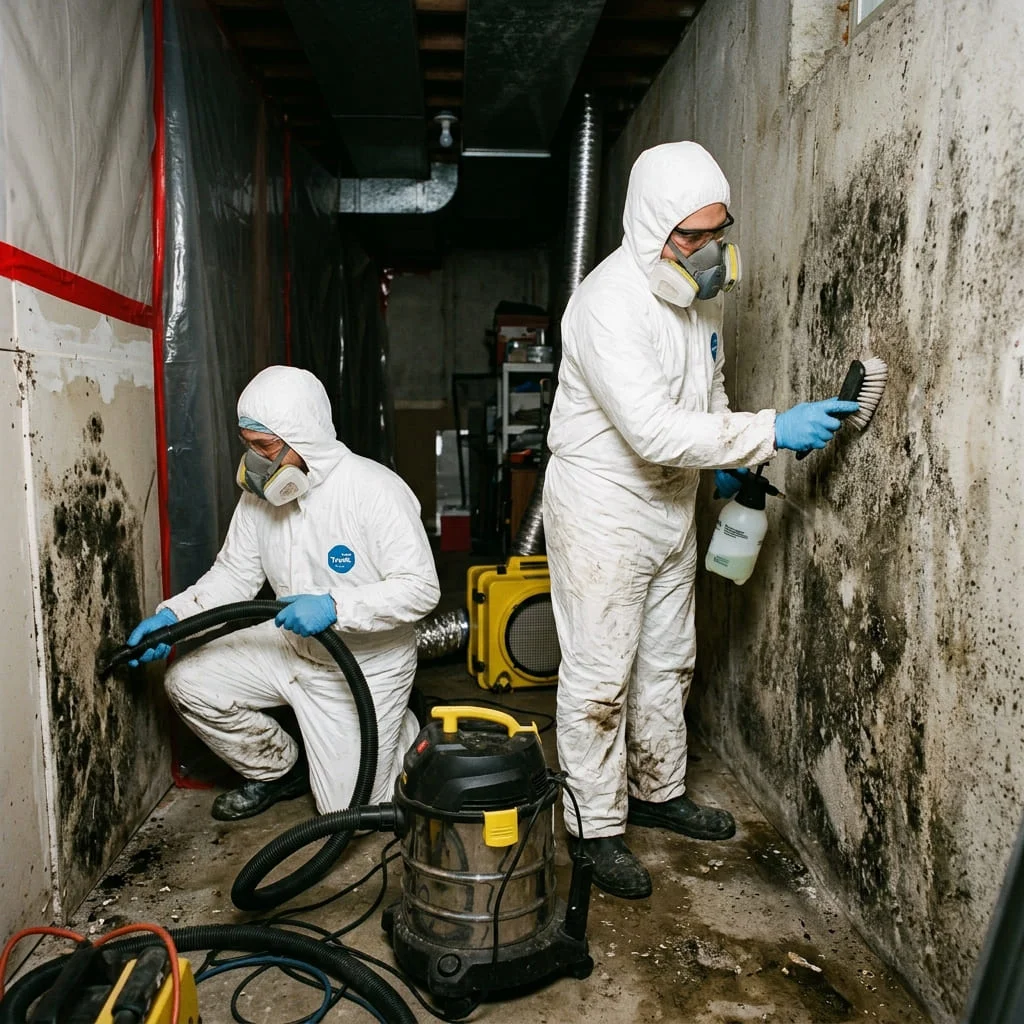 Comparing top-rated mold removal companies serving Gilbert, Arizona
Gilbert went from a farm town to one of the largest municipalities in Arizona in about twenty years, and it built almost all of its housing in one style: two-story stucco over frame on slab, tile roof, production-built between roughly 1995 and 2008. That uniformity creates a mold pattern you do not see as often in the older parts of the valley — because in a two-story house, the laundry room and several bathrooms sit directly above finished living space, and when a supply line, a washer hose, or a shower pan fails upstairs, the water does not spread across a floor where you would see it. It goes into the ceiling of the room below.
Add the lake communities the town is known for — Val Vista Lakes, The Islands, the water features through Power Ranch and Seville — the groundwater recharge basins at the Riparian Preserve, and the flood-irrigated farmland that many neighborhoods were built on, and Gilbert has water in more places than its rainfall totals suggest. Arizona Mold Pros compared the mold removal companies covering Gilbert and the surrounding Southeast Valley. Start with mold inspection and testing if you have a stain with no obvious source, or water damage restoration if water is already down.
Last Updated: September 2026
The companies below serve the Gilbert area. We do not rank them, rate them, or verify their credentials on your behalf — that check is yours to make, and the steps below are the ones worth making it with. Arizona issues no mold-specific license, so the burden of confirming a contractor's licensing, insurance, and scope of work sits with the homeowner.
Arizona issues no mold-specific license, so crews work under a Registrar of Contractors license. Ask for the number and look it up — status, classification, and complaint history are all public.
Request a certificate of liability insurance naming you, sent directly from the insurer or agent rather than a copy from the contractor.
A written scope should name the moisture source, the containment method, what gets removed versus dried, and how completion will be confirmed.
Prices for the same job vary widely. Three written quotes tell you whether an outlier is thorough or simply expensive.
Remediation before the leak is repaired means paying for the same work twice. Any quote silent on the source is incomplete.
For anything past a small area, have post-remediation verification done by someone other than the company that did the removal in Gilbert.
Quality-focused restoration company specializing in mold remediation, water damage, and insurance claim assistance for residential properties.
Professional mold remediation company using advanced moisture detection to eliminate mold and prevent recurrence. Serves Phoenix, Mesa, Chandler, Gilbert, and beyond.
Arizona's leading mold and water damage restoration company specializing in emergency response, mold inspection, and full property restoration.
Mold specialists handling emergency mold removal and remediation with itemized scopes of work.
Mold damage restoration specialists offering inspection, containment, removal, and repairs.
| Service | Average Cost Range |
|---|---|
| Mold Inspection | $300 – $600 |
| Small Area Remediation (under 50 sq ft) | $1,500 – $3,500 |
| Medium Remediation (50–200 sq ft) | $3,500 – $6,000 |
| Full Home Remediation (200+ sq ft) | $5,000 – $10,000 |
| Attic Mold Removal | $2,000 – $6,000 |
| Crawl Space Mold Removal | $2,500 – $7,000 |
| Black Mold Removal | $3,000 – $8,000 |
| Commercial Mold Remediation | $5,000 – $25,000+ |
Costs in Gilbert can vary depending on the size of the affected area, type of mold, accessibility, and whether structural repairs are needed. Arizona's dry climate means mold often concentrates around specific moisture sources — monsoon water intrusion, swamp cooler leaks, or plumbing failures — rather than spreading across entire homes. We recommend getting at least 3 quotes from licensed contractors to compare pricing.
Get free quotes from top Gilbert mold removal companiesThe upstairs-over-living-space problem is Gilbert's signature risk, and it is a consequence of how the town was built. Production two-story plans put the laundry room on the second floor for convenience, along with two or three bathrooms, which means pressurized supply lines, a washer, and shower pans all sit above a ceiling rather than above a slab. A braided washer hose that lets go on a second floor can put hundreds of gallons through a ceiling in an hour, and a slow failure — a weeping angle stop, a shower pan with a failed seal, a toilet flange leaking at each flush — soaks the subfloor and the ceiling cavity below for months without ever reaching a surface you look at.
What makes it worse is where the water ends up. It follows joists sideways, then drops at whatever penetration it reaches first, so the stain on a downstairs ceiling is often nowhere near the fixture that caused it. The first symptom is frequently a faint musty smell in a downstairs room, or a hairline crack in ceiling drywall that was not there before. Any Gilbert homeowner with an upstairs laundry should know where the washer shutoff valves are and should look behind that washer at least once a year — it is the cheapest prevention available in this housing stock, and the most common origin of a ceiling mold remediation job here.
Water around the buildings is the second factor. Gilbert is unusual for a desert town in how much surface water it designed into its neighborhoods: Val Vista Lakes and The Islands are built around man-made lakes with homes fronting directly onto them, Power Ranch and Seville carry their own water features, and the Riparian Preserve at Water Ranch operates recharge basins that put treated water back into the aquifer. None of that raises indoor humidity in any meaningful way — Gilbert is still the Sonoran Desert — but it does mean a great many homes sit close to permanently wet ground with irrigation systems running against them on a timer.
The mechanism that actually causes problems is mundane: grade and spray. Lots in Gilbert's production subdivisions are compact with narrow side yards, and it takes very little settlement for the grade to stop falling away from the foundation. Add landscape drip lines run tight against stucco and turf spray hitting the wall daily, and the base of that wall never fully dries. Stucco that stays damp low will eventually pass moisture into the framing behind it, and the signs are always low on the wall — bubbling paint, softened baseboard, efflorescence on block, flooring lifting along an exterior edge.
Third is the age the town has quietly reached. Gilbert's enormous 1995-to-2008 building cohort is now fifteen to thirty years old, and the components in those houses are hitting end of life together in the same way Surprise's are. Tile roof underlayment at twenty to twenty-five years, water heaters well past a ten-year design life, angle stops and supply hoses stiffening, and air conditioning condensate drains clogging in June — in a two-story house, every one of those failures has a ceiling underneath it.
The attic sits above all of it. Cold supply ducts running through a Gilbert attic that passes 150 degrees in July will sweat wherever insulation has slumped, torn, or been pushed aside, dripping onto the drywall below for an entire cooling season and producing the slow, spreading second-floor ceiling stain that leads to attic mold removal. Because the older farm parcels this housing was built on were flood irrigated for decades, some neighborhoods also carry higher soil moisture than the surrounding desert, which makes prompt drying after any intrusion more important rather than less.
If you own a two-story home in Gilbert — and most of the town does — the highest-value twenty minutes you can spend on mold prevention is behind your upstairs washing machine. Not because washers fail more often here than anywhere else, but because of what sits underneath them. A leak on a second floor has a ceiling below it, and a ceiling cavity is dark, unventilated, insulated, and completely out of sight, which is close to ideal growing conditions.
Pull the washer out far enough to see the wall behind it. Look at the two braided supply hoses: if they are original to a house built in the early 2000s, they are past a typical service life and should be replaced regardless of how they look. Check the angle stops they connect to for mineral crust, green corrosion on brass, or any dampness at the packing nut. Look at the drain standpipe and the floor around it for staining. If there is a drain pan under the machine, confirm it actually drains somewhere rather than simply existing.
Then do the same reasoning for every other upstairs water source. Under each vanity, look for a slow weep at the stops and a softened cabinet floor. At each toilet, check the floor at the base and the ceiling directly below in the room underneath — a flange leak releases a small amount at every flush and will darken a downstairs ceiling long before it does anything visible upstairs. In each shower, look at the grout and the corner seams, and if a downstairs ceiling below a shower has ever been stained, treat a failed pan liner as the leading suspect rather than splashing.
The reason to be systematic about this is that upstairs water does not stay put. It runs sideways along the joists and drops at the first penetration it finds — a can light, a ceiling fan box, a duct boot — so the downstairs stain is frequently in a different room from the fixture that caused it. Do not diagnose by location. If you see a stain on a first-floor ceiling, the question is which upstairs fixture is closest to any point along that joist run, and answering it properly needs moisture readings rather than a guess.
One thing not to do: if you find a stain, resist cutting the ceiling open to look before the water source is identified and shut off. Opening a contaminated cavity without containment spreads spores into rooms that were clean, and it is the most common way a single-room job turns into a three-room one. Get the source found and stopped first, then let the containment go up before anything is opened.
For anything beyond a small area, ask for independent post-remediation verification by someone other than the company that performed the removal — that confirmation is worth most when it comes from a party with no stake in the result. Arizona Mold Pros can connect you with a contractor covering Gilbert — compare mold removal companies in Chandler, Higley, and Queen Creek alongside this page, browse all service areas, or get in touch.
A downstairs ceiling stain in a two-story Gilbert home is worth tracing along the joist run to the nearest upstairs laundry or bathroom fixture, since it's rarely directly below the source.
Bubbling paint or softened baseboard low on a wall near Val Vista Lakes, The Islands, or another irrigated lake-community landscape points to drip lines or turf spray against the foundation, not the lake itself.
A water heater, angle stop, or washer hose original to a home built in Gilbert's 1995-to-2008 boom is worth checking now — this cohort of components across the town is reaching the same age together.
Expect the inspector to trace a downstairs ceiling stain to the nearest upstairs fixture along the joist run rather than assuming the source is directly above.
Near a lake community, expect the inspection to check irrigation placement and grading relative to the foundation.
Given the concentrated age of Gilbert's housing stock, expect a contractor to ask about the age of your water heater, angle stops, and supply hoses as a matter of course.
Mold remediation is one of the few home services where the homeowner carries most of the verification burden. These four checks apply to every contractor on this page, and they are worth running before you sign anything.
Arizona does not issue a license specifically for mold remediation. Crews generally work under an Arizona Registrar of Contractors (ROC) license instead, which means verifying a contractor's ROC status and insurance is on the homeowner rather than on the state.
Check a license at the Arizona ROC →EPA guidance suggests that mold covering roughly more than 10 square feet is generally beyond a do-it-yourself cleanup and warrants professional remediation. Smaller patches can often be handled yourself — provided you have also fixed the moisture source feeding them.
EPA mold cleanup guidance →The ANSI/IICRC S520 standard is the widely recognized standard of care for professional mold remediation, covering containment, worker protection, and verification. A contractor who can tell you how their scope maps to it is giving you something you can hold them to.
Post-remediation verification confirms the work succeeded. Where the budget allows, have it performed by someone independent of the company that did the removal, so the party certifying the result is not the party being paid for it.
How this guide works. Arizona Mold Pros is a directory — we are not the remediation contractor and we do not perform the work ourselves. Listings are compiled from publicly available information about companies advertising mold services in the Gilbert area, and ratings and review counts are approximate figures gathered from public sources that change over time, so verify them yourself before hiring. We may be compensated when a homeowner connects with a contractor through this site. That does not change the evaluation criteria above, and we recommend comparing at least three written scopes regardless of who you call.
Because of what is underneath it. On a slab, a leak spreads across a floor you can see and walk on; on a second floor it goes into the ceiling cavity below — dark, insulated, unventilated, and out of sight. The water also travels sideways along the joists and drops at the first penetration it reaches, such as a can light or a duct boot, so the downstairs stain often appears in a different room from the fixture that caused it. That combination means the problem is usually weeks or months old by the time anyone sees it.
Not before the water source is identified and shut off. Opening a contaminated cavity without containment spreads spores into rooms that were clean, and it is the most common way a single-room job becomes a three-room one. Find and stop the source first — usually an upstairs fixture somewhere along that joist run rather than directly above the stain — then let containment go up before anything is opened. Moisture readings will locate it far more reliably than guessing from where the stain appeared.
Not because of the lake itself. Gilbert is still the Sonoran Desert and a surface water feature does not raise indoor humidity meaningfully. What does cause problems is the irrigation around these homes — drip lines run tight against stucco, turf spray hitting the wall daily, and compact lots where the grade has settled enough that it no longer falls away from the foundation. The base of the wall then never fully dries, and damp stucco eventually passes moisture into the framing behind it.
Costs run the usual $1,500-to-$10,000-plus range. An upstairs leak that traveled along the joists before dropping through a downstairs ceiling can cost more to trace and repair than a same-floor leak, since more of the structure needs to be opened to find the source.
It shows up most often from an upstairs laundry or bathroom leak traveling into a downstairs ceiling, from irrigation running against a foundation near a lake community, or from an aging water heater or supply hose original to the 1995-to-2008 boom cohort.
Check upstairs washer hoses and angle stops yearly — the single highest-value check in this town's housing stock. Keep irrigation and drip lines off stucco walls. If your water heater is original to the house, check its manufacture date rather than trusting memory.
Don't wait for mold to spread. Compare the top-rated mold removal contractors serving Gilbert and the surrounding area. Get your free estimate today — no obligation, no pressure.
Call Now for Free QuotesFree estimates · No obligation · Licensed contractors