Preferred Choice Restoration
Quality-focused restoration company specializing in mold remediation, water damage, and insurance claim assistance for residential properties.
Services Tempe and the surrounding area
Compare ratings, reviews, and services from the best mold remediation contractors serving Tempe and the surrounding area — then get matched with a free, no-obligation quote.
 Comparing top-rated mold removal companies serving Tempe, Arizona
Tempe has the oldest housing stock of any major East Valley city, and that single fact drives most of its mold problems. Landlocked between Phoenix, Scottsdale, Mesa, and Chandler, Tempe finished growing outward decades ago — there is essentially no greenfield left — so instead of new subdivisions the city has neighborhoods like Maple-Ash, Broadmor, Mitchell Park, and Hudson Manor full of 1950s and 1960s slump block and frame ranch homes, many with original plumbing still in the slab and original roof penetrations where an evaporative cooler used to sit.
Layered over that is the largest student rental market in Arizona. A very large share of Tempe housing near Arizona State University is tenant-occupied with annual turnover, and a slow leak in a rental is a leak nobody has a financial reason to chase. Arizona Mold Pros compared the mold removal companies working Tempe and the surrounding East Valley so you can weigh coverage and response time before you call. If you are chasing a musty smell in an older house, start with mold inspection and testing; if a line has already failed, water damage restoration is the urgent step.
Last Updated: September 2026
The companies below serve the Tempe area. We do not rank them, rate them, or verify their credentials on your behalf — that check is yours to make, and the steps below are the ones worth making it with. Arizona issues no mold-specific license, so the burden of confirming a contractor's licensing, insurance, and scope of work sits with the homeowner.
Arizona issues no mold-specific license, so crews work under a Registrar of Contractors license. Ask for the number and look it up — status, classification, and complaint history are all public.
Request a certificate of liability insurance naming you, sent directly from the insurer or agent rather than a copy from the contractor.
A written scope should name the moisture source, the containment method, what gets removed versus dried, and how completion will be confirmed.
Prices for the same job vary widely. Three written quotes tell you whether an outlier is thorough or simply expensive.
Remediation before the leak is repaired means paying for the same work twice. Any quote silent on the source is incomplete.
For anything past a small area, have post-remediation verification done by someone other than the company that did the removal in Tempe.
Quality-focused restoration company specializing in mold remediation, water damage, and insurance claim assistance for residential properties.
Professional mold remediation company using advanced moisture detection to eliminate mold and prevent recurrence. Serves Phoenix, Mesa, Chandler, Gilbert, and beyond.
Arizona's leading mold and water damage restoration company specializing in emergency response, mold inspection, and full property restoration.
Mold specialists handling emergency mold removal and remediation with itemized scopes of work.
Mold damage restoration specialists offering inspection, containment, removal, and repairs.
| Service | Average Cost Range |
|---|---|
| Mold Inspection | $300 – $600 |
| Small Area Remediation (under 50 sq ft) | $1,500 – $3,500 |
| Medium Remediation (50–200 sq ft) | $3,500 – $6,000 |
| Full Home Remediation (200+ sq ft) | $5,000 – $10,000 |
| Attic Mold Removal | $2,000 – $6,000 |
| Crawl Space Mold Removal | $2,500 – $7,000 |
| Black Mold Removal | $3,000 – $8,000 |
| Commercial Mold Remediation | $5,000 – $25,000+ |
Costs in Tempe can vary depending on the size of the affected area, type of mold, accessibility, and whether structural repairs are needed. Arizona's dry climate means mold often concentrates around specific moisture sources — monsoon water intrusion, swamp cooler leaks, or plumbing failures — rather than spreading across entire homes. We recommend getting at least 3 quotes from licensed contractors to compare pricing.
Get free quotes from top Tempe mold removal companiesMid-century plumbing is the first and largest Tempe risk. Homes built in the 1950s and 1960s were plumbed with galvanized steel supply lines and cast iron drain lines, both of which corrode from the inside out over a service life that is now long exhausted. Galvanized pipe fails as a pinhole weep rather than a burst, and when it is buried in a slab or running inside a wall, that weep can feed a wall cavity for months while producing nothing visible on the surface except, eventually, a smell.
Cast iron waste lines fail differently and worse. As the pipe wall thins, joints separate and drain water escapes below the slab or inside a wall — greywater rather than clean supply water, which brings its own contamination on top of the moisture. If your Tempe home is pre-1970 and has never been repiped, a musty odor near a bathroom or kitchen wall should be treated as a plumbing report rather than a cleaning problem, and the inspection needs moisture mapping rather than a visual once-over.
Evaporative cooling is the second, and Tempe's older neighborhoods are full of its legacy. A swamp cooler adds moisture to the house by design — that is how it cools — so a unit still in service with aged ducting or a bleed-off line that drips onto the roof deck is a standing humidity source all summer. Homes that converted to refrigerated air often left the roof penetration behind, capped quickly and then forgotten, and a badly sealed abandoned cooler opening is one of the most reliable roof leaks in the city.
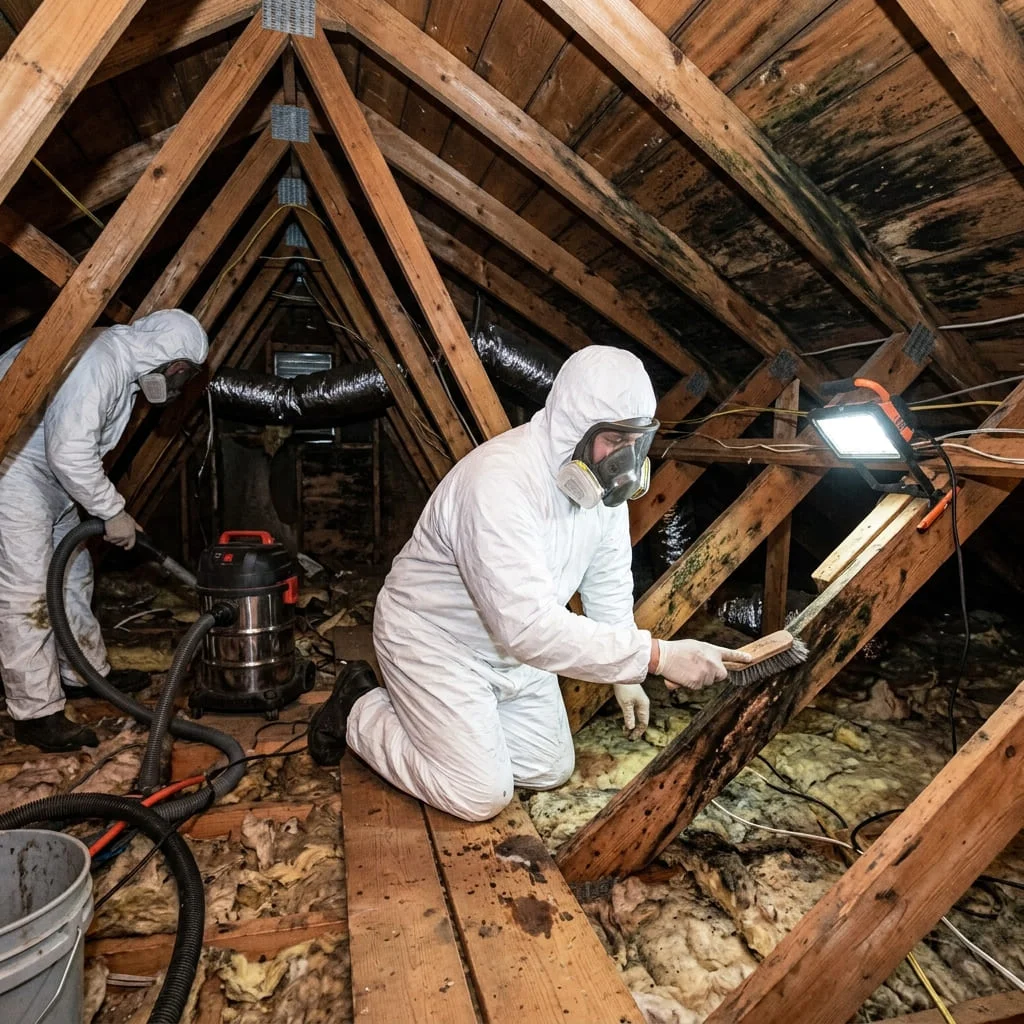
The attic beneath it compounds the problem. Mid-century Tempe homes tend to have shallow attics with modest insulation, and where later owners ran air conditioning ducts through that space, cold supply air meets attic temperatures well over 150 degrees in July. Any gap in the duct insulation sweats and drips onto the ceiling drywall below for a whole season. Between the old penetration above and the sweating duct below, the attic is where a large share of Tempe mold begins — the standard path to attic mold removal here.
The rental market is the third factor and the one that turns small problems into large ones. Tempe's proximity to Arizona State University means a high share of housing is tenant-occupied, often with yearly turnover, and the incentives work against early reporting: a tenant who will move out in May has little reason to chase a slow bathroom leak in February, and an off-site owner has no way to notice it. By the time a unit turns over and someone actually looks behind the vanity, the wall cavity has been wet for a semester.
Older multifamily makes it worse. Tempe has a substantial stock of 1960s through 1980s apartment buildings and condominiums, where shared plumbing stacks mean a leak in one unit becomes a mold problem in the unit below or beside it, and where responsibility between owner, tenant, and association is rarely settled quickly. For buildings like these, the work needs to be scoped so the rest of the property stays occupied, which is a different job from a single-family remediation — see commercial mold removal for how multi-unit projects are usually staged.
If you own or rent a mid-century home in Maple-Ash, Broadmor, Mitchell Park, Hudson Manor, or any of the older grid neighborhoods around downtown Tempe and campus, a visual inspection alone is close to useless. The failure modes in these houses are almost all concealed, and an inspector who only looks at what is visible will confirm what you already suspected and miss what is actually feeding it.
Ask specifically whether the inspection includes moisture meter readings on the wall base and slab, not just a walk-through. In a slab-on-grade house with original galvanized supply lines, the diagnostic question is whether there is elevated moisture in the slab or the bottom plate in a specific location, and that is a reading, not an opinion. A thermal camera is useful for narrowing where to take those readings, but it detects temperature difference rather than moisture, so readings should always confirm what the camera suggests.
Second, ask the inspector to look at the roof for current and former evaporative cooler penetrations, then check the underside of each one from inside the attic. Staining, rust streaking, or darkened sheathing directly above a ceiling stain is the shortest path from symptom to cause in this housing stock. While they are up there, the duct runs should be checked for slumped or torn insulation, disconnected collars, and damp fiberglass, particularly where a duct passes over a bathroom or closet.
Third, if the house is pre-1970 and has never been repiped, say so on the first call. It changes what the contractor brings and what they look for. A drain leak from a failing cast iron waste line is a different scope than a clean supply leak, because drain water is contaminated — the affected material generally has to be removed rather than dried in place, and the plumbing repair has to happen before any remediation is worth paying for. Any contractor who proposes replacing drywall without identifying and fixing the water source is selling you the same repair twice.
Renters and landlords should both know how this usually goes wrong. Put every report of a leak, a stain, or a musty smell in writing with a date and a photograph, and keep your own copy. Most disputes in Tempe rental housing are not about whether mold exists but about when it was first reported, and a dated written record settles that question immediately. Under Arizona residential landlord-tenant law a written repair request starts a documented clock, which is worth far more to you than a phone call nobody logged.
Arizona Mold Pros can connect you with a contractor covering Tempe — compare mold removal companies in Chandler, Gilbert, and Paradise Valley alongside this page, browse all service areas, or get in touch.
A musty smell in a pre-1970 Tempe home with nothing visible on the surface is worth taking seriously — galvanized supply lines and cast iron drains fail as slow weeps and separated joints, producing an odor long before a stain.
A ceiling stain under a current or former roof-mounted evaporative cooler penetration in Maple-Ash, Broadmor, or another mid-century neighborhood points to a failed cap or seal rather than general roof wear.
A slow leak reported late in a rental near ASU — because a tenant with months left on a lease has little reason to chase it — is a real risk factor here, not just a hypothetical.
In a pre-1970 home, expect the inspection to include moisture meter readings on the wall base and slab rather than just a visual walkthrough.
Expect the inspector to check the roof for current and former evaporative cooler penetrations and look at the underside from inside the attic.
If you rent, expect your position to depend on having put the report in writing with a date and photographs — a phone call alone doesn't create the record a dispute later turns on.
Mold remediation is one of the few home services where the homeowner carries most of the verification burden. These four checks apply to every contractor on this page, and they are worth running before you sign anything.
Arizona does not issue a license specifically for mold remediation. Crews generally work under an Arizona Registrar of Contractors (ROC) license instead, which means verifying a contractor's ROC status and insurance is on the homeowner rather than on the state.
Check a license at the Arizona ROC →EPA guidance suggests that mold covering roughly more than 10 square feet is generally beyond a do-it-yourself cleanup and warrants professional remediation. Smaller patches can often be handled yourself — provided you have also fixed the moisture source feeding them.
EPA mold cleanup guidance →The ANSI/IICRC S520 standard is the widely recognized standard of care for professional mold remediation, covering containment, worker protection, and verification. A contractor who can tell you how their scope maps to it is giving you something you can hold them to.
Post-remediation verification confirms the work succeeded. Where the budget allows, have it performed by someone independent of the company that did the removal, so the party certifying the result is not the party being paid for it.
How this guide works. Arizona Mold Pros is a directory — we are not the remediation contractor and we do not perform the work ourselves. Listings are compiled from publicly available information about companies advertising mold services in the Tempe area, and ratings and review counts are approximate figures gathered from public sources that change over time, so verify them yourself before hiring. We may be compensated when a homeowner connects with a contractor through this site. That does not change the evaluation criteria above, and we recommend comparing at least three written scopes regardless of who you call.
That combination usually points at concealed plumbing. Homes of that era were built with galvanized supply lines and cast iron drain lines, both of which fail as slow weeps and separated joints rather than dramatic bursts, and a leak inside a wall or under a slab produces an odor long before it produces a stain. Ask for an inspection that includes moisture meter readings on the wall base and slab rather than a visual walk-through, because the visible surface in these houses is usually the last place the problem shows up.
Report it to your landlord or property manager in writing, with the date and photographs, and keep your own copy. Most Tempe rental disputes turn on when a problem was first reported rather than whether it exists, and a dated written request creates a record a phone call does not. Note the specific location and any water source you can see, keep the area ventilated to the outside rather than circulating air into the rest of the unit, and do not paint or clean over growth before it has been documented.
Frequently, yes. Many mid-century Tempe homes converted from evaporative cooling to refrigerated air, and the roof penetration left behind was often capped quickly and then never maintained. A failed cap lets monsoon rain straight onto the roof deck, and because the opening sits over a shallow attic the water reaches ceiling drywall fast. If your house ever had a roof-mounted cooler, that penetration should be the first thing an inspector checks from both the roof and the attic side.
Costs run the usual $1,500-to-$10,000-plus range. A pre-1970 home with a failing cast iron drain line can run higher, since a drain leak is contaminated water and the affected material generally has to be removed rather than dried, and the plumbing repair has to happen before remediation is worth paying for.
It shows up most often from concealed galvanized or cast iron plumbing in the city's mid-century housing stock, from a failed evaporative cooler roof penetration, or from a rental leak that went unreported for months.
If your pre-1970 home has never been repiped, say so before booking any work — it changes what the contractor needs to check. Have any former evaporative cooler roof penetration inspected from both the roof and attic side. Renters should report any leak or smell in writing with a date the moment it's noticed.
Don't wait for mold to spread. Compare the top-rated mold removal contractors serving Tempe and the surrounding area. Get your free estimate today — no obligation, no pressure.
Call Now for Free QuotesFree estimates · No obligation · Licensed contractors