SERVPRO of Tucson Valley
Locally owned franchise of the national restoration brand, handling mold remediation, water damage, and structural drying across the Tucson metro with 24/7 emergency dispatch.
Compare ratings, reviews, and services from the best mold remediation contractors serving Sasabe and the surrounding area — then get matched with a free, no-obligation quote.
Comparing top-rated mold removal companies serving Sasabe, ArizonaSasabe sits at the southern end of AZ-286, where the road out of the Altar Valley reaches the international border and the crossing into El Sásabe, Sonora. It is one of the smallest and most remote communities in Arizona: about 70 miles southwest of Tucson, reached by driving west on AZ-86 to Three Points and then south for the better part of an hour through open grassland, with the Buenos Aires National Wildlife Refuge occupying much of the country on either side of the highway. Elevation here is around 3,500 feet, which makes it cooler and somewhat wetter than the Tucson basin, and the surrounding land is ranching country.
What makes Sasabe genuinely distinct for mold purposes is what the buildings are made of. The area has a long association with adobe and earthen construction, and earthen walls do not handle water the way a stud wall with drywall does. They can be extraordinarily durable — there are adobe buildings across southern Arizona that have stood for well over a century — but they are durable under a specific condition: they must be able to dry. Sealing an adobe wall with the wrong material is one of the most common and most damaging mistakes made on buildings of this type, and it is a mistake that shows up as deterioration and biological growth at the base of the wall.
Arizona Mold Pros compared the mold remediation contractors covering southern Pima County so Sasabe property owners can weigh coverage, response time, and emergency availability in one place, because very few firms are within an easy drive of AZ-286. If you have found damp or crumbling wall base, staining, or a persistent musty smell, start with mold inspection and testing; if a well line or plumbing run has failed, water damage restoration is the urgent step.
Last Updated: July 2026
Every company listed below is evaluated on customer reviews, Google ratings, licensing and insurance status, response time and availability, the range of mold services offered, and experience with Arizona-specific mold issues like monsoon moisture and swamp cooler condensation. We only feature companies that actively serve the Sasabe area.
Verified Google ratings and the volume and consistency of homeowner reviews.
Companies that carry the licensing and insurance Arizona homeowners should expect.
How quickly a company can be on site — including 24/7 emergency coverage.
Inspection, testing, remediation, and water damage restoration under one roof.
Familiarity with monsoon moisture, swamp cooler condensation, and desert construction.
Only companies that actively serve the Sasabe area make our list.
Locally owned franchise of the national restoration brand, handling mold remediation, water damage, and structural drying across the Tucson metro with 24/7 emergency dispatch.
Neighborly-affiliated restoration franchise handling mold remediation, water damage mitigation, and odor removal for residential and light commercial properties.
Full-service restoration franchise covering southern Arizona, offering mold remediation, water and fire damage repair, and reconstruction under one contract.
Emergency-focused franchise providing same-day mold removal and water damage response across Tucson and the surrounding Pima County communities.
Tucson-based restoration contractor specializing in mold remediation, moisture mapping, and structural drying, with independent testing available on request.
| Service | Average Cost Range |
|---|---|
| Mold Inspection | $300 – $600 |
| Small Area Remediation (under 50 sq ft) | $1,500 – $3,500 |
| Medium Remediation (50–200 sq ft) | $3,500 – $6,000 |
| Full Home Remediation (200+ sq ft) | $5,000 – $10,000 |
| Attic Mold Removal | $2,000 – $6,000 |
| Crawl Space Mold Removal | $2,500 – $7,000 |
| Black Mold Removal | $3,000 – $8,000 |
| Commercial Mold Remediation | $5,000 – $25,000+ |
Costs in Sasabe can vary depending on the size of the affected area, type of mold, accessibility, and whether structural repairs are needed. Arizona's dry climate means mold often concentrates around specific moisture sources — monsoon water intrusion, swamp cooler leaks, or plumbing failures — rather than spreading across entire homes. We recommend getting at least 3 quotes from licensed contractors to compare pricing.
Compare free quotes from top Sasabe mold removal companiesEarthen walls are the first thing any contractor working in Sasabe needs to understand. Adobe and similar earthen construction is vapor open by design: it absorbs moisture and then releases it, and traditional lime or mud plasters are breathable specifically so that cycle can continue. Problems begin when a well-intentioned modernization coats an earthen wall in hard cement stucco or a plastic-based paint. Water still gets into the wall — from rain, from splash-back at grade, from ground moisture wicking upward, from a plumbing leak inside — but it can no longer get out through the face. It accumulates behind the impermeable layer, and the wall begins to deteriorate from within.
The signature is unmistakable once you know it: damage concentrated at the base of the wall, stucco bulging or spalling off in sheets, powdery or crumbling material behind it, white salt deposits blooming on the surface, and persistent damp with a musty smell in the lowest few feet of the room. Interior finishes applied over that wall — drywall furred out, vinyl wallpaper, latex paint — give mold a food source right where the moisture is concentrated. Remediation on an earthen building is not simply a matter of cutting out drywall; the moisture path through the wall itself has to be addressed, which means anyone scoping the work should be asking what the wall is made of before they quote it.
The second factor is the ground and the weather that lands on it. The Altar Valley is open semi-desert grassland cut by washes, and the summer monsoon delivers most of the year's rain in intense bursts from July through September. Water crosses open ground fast, and at this elevation storms can be heavy. Buildings on flat ground with grading that has settled over the years — which describes a great many older rural properties — end up with water pooling against the base of a wall exactly where an earthen or masonry building can least afford it. Splash-back off unpaved ground during a hard storm drives moisture into the lower wall face repeatedly through the season.
Roof detailing decides how bad this gets. A traditional earthen building is protected by generous roof overhangs that throw water clear of the wall, and by drainage that carries it away from the foundation. Where an overhang is short, a canale or downspout discharges next to the wall, or a later addition has changed the roofline, you get a concentrated wetting point that repeats every storm. Before anything else, walk the perimeter after a storm and look for where water actually goes — that observation is worth more than any test, and it is what a good mold inspection in Sasabe should start with.
Third is everything that comes with being this rural. There is no municipal water or sewer, so properties run on private wells and septic systems, which puts pressure tanks, pump houses, and buried supply lines outside the part of the building anybody inspects. A leak in any of them is found by smell or by a rising power bill rather than by a puddle. Ranch properties add outbuildings, tack rooms, barns, and storage structures that are visited occasionally and ventilated poorly, and those are where a moisture problem can run for a full season unnoticed.
Manufactured and mobile homes are common in this part of the county too, and they fail in their own particular way: water that reaches the belly wrap and underfloor insulation stays there for a very long time, so the damage sits under the floor and is usually found only when the flooring softens or the smell becomes undeniable. Whatever the structure, the remoteness is the multiplier — Sasabe is roughly an hour and a half from Tucson, so nothing gets looked at casually and small problems get large before anyone with a moisture meter sees them. If a room smells earthy and you cannot find why, treat it as a finding rather than a nuisance; that is the same starting point behind genuine black mold removal, crawl space mold removal, and full mold remediation.

If you own an adobe or earthen-walled building anywhere in the Altar Valley, this is the single most useful thing to understand about it: the wall stays sound because it dries, not because it is sealed. Earthen construction absorbs moisture and gives it back to the air, and that exchange happens through the wall face. Traditional lime and mud plasters are chosen precisely because they are permeable enough to let it happen while still shedding rain. The system works, and it has worked on buildings across southern Arizona for well over a hundred years.
Hard cement stucco breaks it. Cement plaster is far less permeable than the earthen wall behind it, and it is also far more rigid, so it cracks as the building moves. Water enters through those cracks, through the top of the wall, from splash-back at grade, and by wicking up from the ground — and then it cannot leave, because the face is sealed. Trapped moisture accumulates at the bottom of the wall where gravity takes it, softens the adobe, mobilizes salts that crystallize and push the coating off, and creates a permanently damp zone that supports mold on any organic finish nearby. Homeowners often read the bulging, spalling stucco as a stucco failure and patch it with more cement, which accelerates the whole process. Plastic-based exterior paints do the same thing on a smaller scale.
What to do instead follows directly. Deal with the water before you deal with the wall: correct the grading so the ground falls away from the building, move downspout and canale discharge well clear of the base, extend or repair roof overhangs where they are throwing water onto the wall, and keep irrigation and dense plantings away from the perimeter. Then, when repairing the wall face, use breathable materials — lime-based or earthen plasters compatible with what is behind them — rather than cement. If cement stucco is already in place and the wall behind it is deteriorating, removing it is often the actual repair, and that is a job for someone who has worked on earthen buildings before rather than a general remodeler.
Inside, the same principle applies to how remediation is scoped. Furring out an adobe wall and covering it with drywall and vinyl wallpaper creates a cavity that traps moisture against the earthen face and hands mold an organic food source in the exact spot where the wall is wettest. When you have work done, ask what will go back on the wall and why, and be wary of a scope that treats an earthen wall as though it were framing. Tell the contractor what the building is made of when you first call — it changes the diagnosis, the demolition plan, and the reconstruction, and a firm that has never worked on adobe should say so.
The rest is the ordinary discipline of a remote property. Photograph damage before anything moves, get a written scope that says how far beyond the visible damage material will be removed and confirms that containment and HEPA filtration go up before demolition rather than after, keep the moisture readings and drying logs, and for anything beyond a small contained patch have post-remediation verification performed by someone independent of the company that did the removal. Arizona Mold Pros can connect you with a licensed contractor covering the Sasabe area — compare listings for mold removal companies in Arivaca, Green Valley, and Marana, browse all service areas, or get in touch.
The most obvious sign is visible growth — black, green, or white spots spreading across walls and ceilings, under sinks, or around window frames. But mold in Sasabe homes often hides, so a persistent musty or earthy odor in a bathroom, closet, or other enclosed space is just as important to take seriously. That smell usually means moisture is feeding something you can't yet see.
Context matters too. If your Sasabe home has had recent water damage, flooding, or a plumbing leak, mold can begin growing within 24 to 48 hours. Watch for peeling paint, bubbling wallpaper, or discoloration on surfaces, and pay attention to condensation collecting on windows or walls. Unexplained respiratory symptoms, worsening allergies, or headaches that ease when you leave the house can also point to a hidden mold problem.
If you notice any of these signs in your Sasabe home, contact a licensed mold remediation professional for an inspection before the problem spreads.
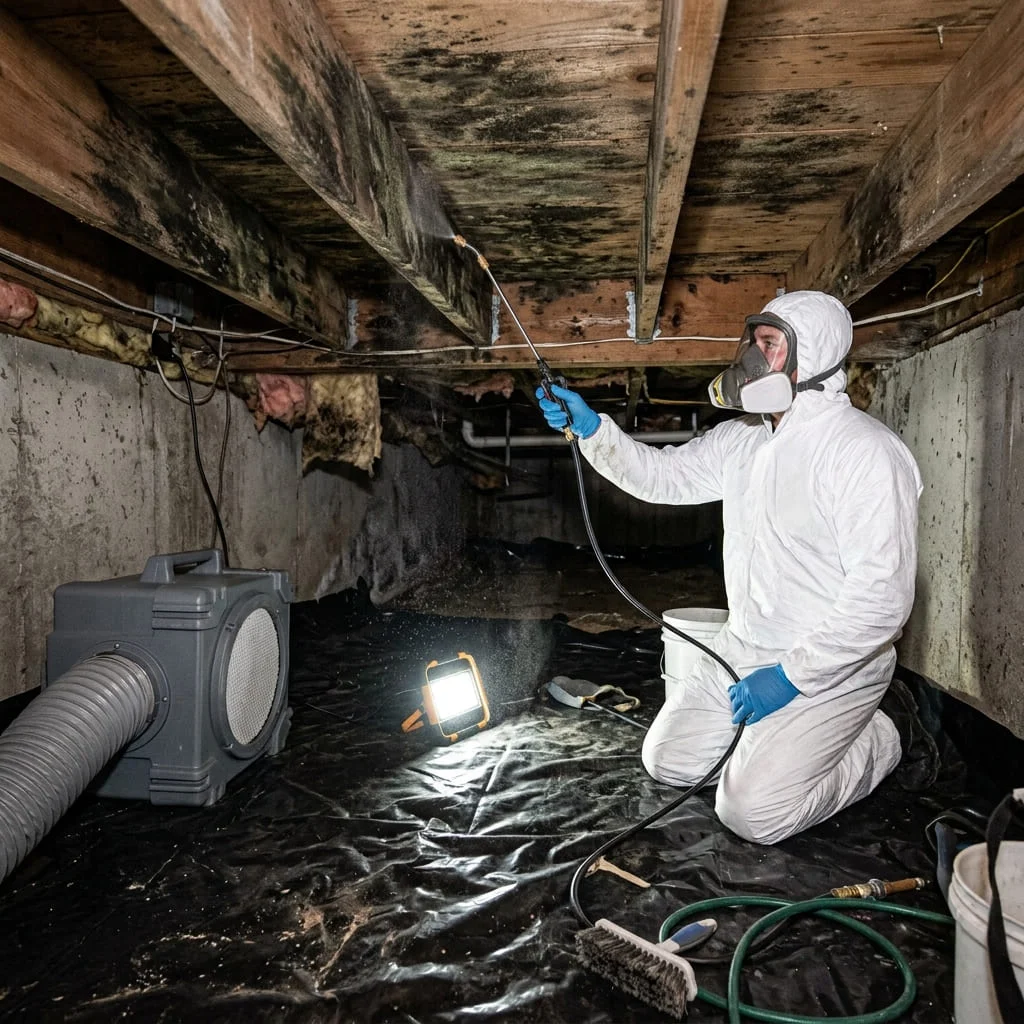
A quality mold removal company in Sasabe starts with an inspection and assessment to identify the type of mold and the extent of the problem. Once the scope is clear, the crew contains the affected area with plastic sheeting and negative air pressure so spores don't spread to clean parts of the house, then runs HEPA air filtration to capture anything airborne.
From there, the actual remediation begins: physical removal of mold using antimicrobial treatments and scrubbing, followed by thorough drying and dehumidification of the affected areas. Any damaged materials — drywall, insulation, or flooring — are repaired or replaced, and reputable contractors finish with post-remediation testing to confirm mold levels are back to normal.
The best mold removal companies serving Sasabe will provide a detailed scope of work and walk you through each step before starting any remediation.
Mold remediation is one of the few home services where the homeowner carries most of the verification burden. These four checks apply to every contractor on this page, and they are worth running before you sign anything.
Arizona does not issue a license specifically for mold remediation. Crews generally work under an Arizona Registrar of Contractors (ROC) license instead, which means verifying a contractor's ROC status and insurance is on the homeowner rather than on the state.
Check a license at the Arizona ROC →EPA guidance suggests that mold covering roughly more than 10 square feet is generally beyond a do-it-yourself cleanup and warrants professional remediation. Smaller patches can often be handled yourself — provided you have also fixed the moisture source feeding them.
EPA mold cleanup guidance →The ANSI/IICRC S520 standard is the widely recognized standard of care for professional mold remediation, covering containment, worker protection, and verification. A contractor who can tell you how their scope maps to it is giving you something you can hold them to.
Post-remediation verification confirms the work succeeded. Where the budget allows, have it performed by someone independent of the company that did the removal, so the party certifying the result is not the party being paid for it.
How this guide works. Arizona Mold Pros is a directory — we are not the remediation contractor and we do not perform the work ourselves. Listings are compiled from publicly available information about companies advertising mold services in the Sasabe area, and ratings and review counts are approximate figures gathered from public sources that change over time, so verify them yourself before hiring. We may be compensated when a homeowner connects with a contractor through this site. That does not change the evaluation criteria above, and we recommend comparing at least three written scopes regardless of who you call.
That pattern almost always means moisture is trapped in the wall rather than drying out of it. Earthen walls are vapor open by design and need a breathable finish; a hard cement stucco or plastic-based paint lets water in through cracks and from the ground but stops it leaving through the face. It collects at the base, softens the adobe, and pushes salts and the coating outward. Fix the water first — grading, roof overhangs, downspout discharge — then repair the face with lime-based or earthen plaster, not more cement.
The earthen material itself is a poor food source, but the situation around it is the problem. A wall held permanently damp supports growth on anything organic nearby — furring, drywall, wallpaper, paint binders, baseboard, stored belongings — and that is exactly what gets installed over adobe in modern remodels. The persistent damp and musty smell in the lower few feet of a room is the warning. Remediation has to address the moisture path through the wall, not just replace the finishes over it.
About an hour and a half from Tucson, down AZ-86 to Three Points and then south on AZ-286. Very few firms are within easy reach, so expect a travel charge, confirm coverage explicitly, and ask how drying will be monitored across the following days, since proper structural drying needs moisture readings taken until materials reach a documented dry standard. Mention on the first call that the property is on a well and septic, and say what the walls are made of if the building is adobe.
Mold removal costs in Sasabe typically range from $1,500 for small areas to $10,000 or more for full-home remediation. The exact cost depends on the size of the affected area, type of mold, and whether structural repairs are needed. We recommend getting at least 3 quotes from licensed contractors.
Most residential mold remediation jobs in Sasabe take 1 to 5 days. Larger projects involving multiple rooms, extensive water damage, or structural repairs can take up to 2 weeks. Your contractor should provide a timeline before work begins.
It depends on the cause. Arizona homeowners insurance typically covers mold remediation if the mold resulted from a sudden, accidental event like a burst pipe or storm damage. Mold caused by ongoing neglect, deferred maintenance, or pre-existing conditions is usually not covered. Check with your insurance provider for specifics.
Yes. Despite Arizona's dry climate, black mold (Stachybotrys chartarum) can develop anywhere with persistent moisture — bathrooms, attics, crawl spaces, and behind walls near plumbing. Monsoon season, swamp coolers, and water heater failures are common causes of black mold growth in Sasabe homes.
It depends on the severity. For small, contained areas, you can usually stay home while the remediation crew works. For larger projects involving multiple rooms or HVAC system contamination, temporary relocation may be recommended — especially for households with children, elderly family members, or anyone with respiratory conditions.
Fix the moisture source first — that's the number one priority. After that, improve ventilation in bathrooms and kitchens, use exhaust fans, consider a dehumidifier for enclosed spaces, and schedule regular inspections especially before and after monsoon season (July through September). In Sasabe, pay extra attention to swamp cooler areas and any rooms adjacent to exterior plumbing.
Don't wait for mold to spread. Compare the top-rated mold removal contractors serving Sasabe and the surrounding area. Get your free estimate today — no obligation, no pressure.
Call Now for Free QuotesFree estimates · No obligation · Licensed contractors