SERVPRO of Litchfield / West Phoenix
National brand with local ownership serving the West Valley including Litchfield Park, Tolleson, Avondale, and Goodyear for mold remediation and water damage.
Services Sun City West and the surrounding area
Compare ratings, reviews, and services from the best mold remediation contractors serving Sun City West and the surrounding area — then get matched with a free, no-obligation quote.
 Comparing top-rated mold removal companies serving Sun City West, Arizona
Sun City West opened in 1978 and kept building into the late 1990s, which puts its housing roughly two decades younger than original Sun City — and gives it a completely different set of mold triggers. Instead of flat carport roofs and swamp coolers, the typical Sun City West home has a tile roof, refrigerated air with the air handler and ducts up in the attic, and plumbing installed during a period when the materials used in residential construction were changing fast. Each of those is now old enough to matter.
Arizona Mold Pros compared the mold remediation contractors serving Sun City West and the surrounding northwest Valley on ratings, emergency response, and range of services, so you can see who is worth calling before you start dialing. Whether you are chasing a ceiling stain after a monsoon storm, a musty smell in a guest room nobody uses, or the aftermath of a water heater failure, start with mold inspection and testing and compare the companies below.
Last Updated: September 2026
The companies below serve the Sun City West area. We do not rank them, rate them, or verify their credentials on your behalf — that check is yours to make, and the steps below are the ones worth making it with. Arizona issues no mold-specific license, so the burden of confirming a contractor's licensing, insurance, and scope of work sits with the homeowner.
Arizona issues no mold-specific license, so crews work under a Registrar of Contractors license. Ask for the number and look it up — status, classification, and complaint history are all public.
Request a certificate of liability insurance naming you, sent directly from the insurer or agent rather than a copy from the contractor.
A written scope should name the moisture source, the containment method, what gets removed versus dried, and how completion will be confirmed.
Prices for the same job vary widely. Three written quotes tell you whether an outlier is thorough or simply expensive.
Remediation before the leak is repaired means paying for the same work twice. Any quote silent on the source is incomplete.
For anything past a small area, have post-remediation verification done by someone other than the company that did the removal in Sun City West.
National brand with local ownership serving the West Valley including Litchfield Park, Tolleson, Avondale, and Goodyear for mold remediation and water damage.
Environmental remediation company handling mold removal, asbestos abatement, and related remediation work.
General contractor offering mold removal, testing, water damage restoration, and reconstruction.
General contractor handling mold remediation, with an emphasis on assessment and a written scope before work begins.
Mold remediation specialists handling containment, removal, and structural drying.
| Service | Average Cost Range |
|---|---|
| Mold Inspection | $300 – $600 |
| Small Area Remediation (under 50 sq ft) | $1,500 – $3,500 |
| Medium Remediation (50–200 sq ft) | $3,500 – $6,000 |
| Full Home Remediation (200+ sq ft) | $5,000 – $10,000 |
| Attic Mold Removal | $2,000 – $6,000 |
| Crawl Space Mold Removal | $2,500 – $7,000 |
| Black Mold Removal | $3,000 – $8,000 |
| Commercial Mold Remediation | $5,000 – $25,000+ |
Costs in Sun City West can vary depending on the size of the affected area, type of mold, accessibility, and whether structural repairs are needed. Arizona's dry climate means mold often concentrates around specific moisture sources — monsoon water intrusion, swamp cooler leaks, or plumbing failures — rather than spreading across entire homes. We recommend getting at least 3 quotes from licensed contractors to compare pricing.
Get free quotes from top Sun City West mold removal companiesThe tile roof is the risk most Sun City West owners underestimate, because the part that fails is the part you cannot see. Concrete and clay tiles are enormously durable and can look perfect for decades, but the tiles themselves are not what keeps water out — the underlayment beneath them does, and felt underlayment is generally considered to have a service life in the range of twenty to thirty years. On homes built between 1978 and the late 1990s, that clock has run out unless the roof has already been stripped and re-underlaid.
When underlayment fails, water gets past it in small volumes during each storm and tracks along the roof deck before it appears anywhere visible. The result is often attic sheathing and framing that have been intermittently wet for years before a ceiling stain finally shows up in a hallway. If you have never had the underlayment assessed and you are seeing discoloration on a ceiling after monsoon rain, treat it as a roofing and attic mold investigation rather than a paint problem.
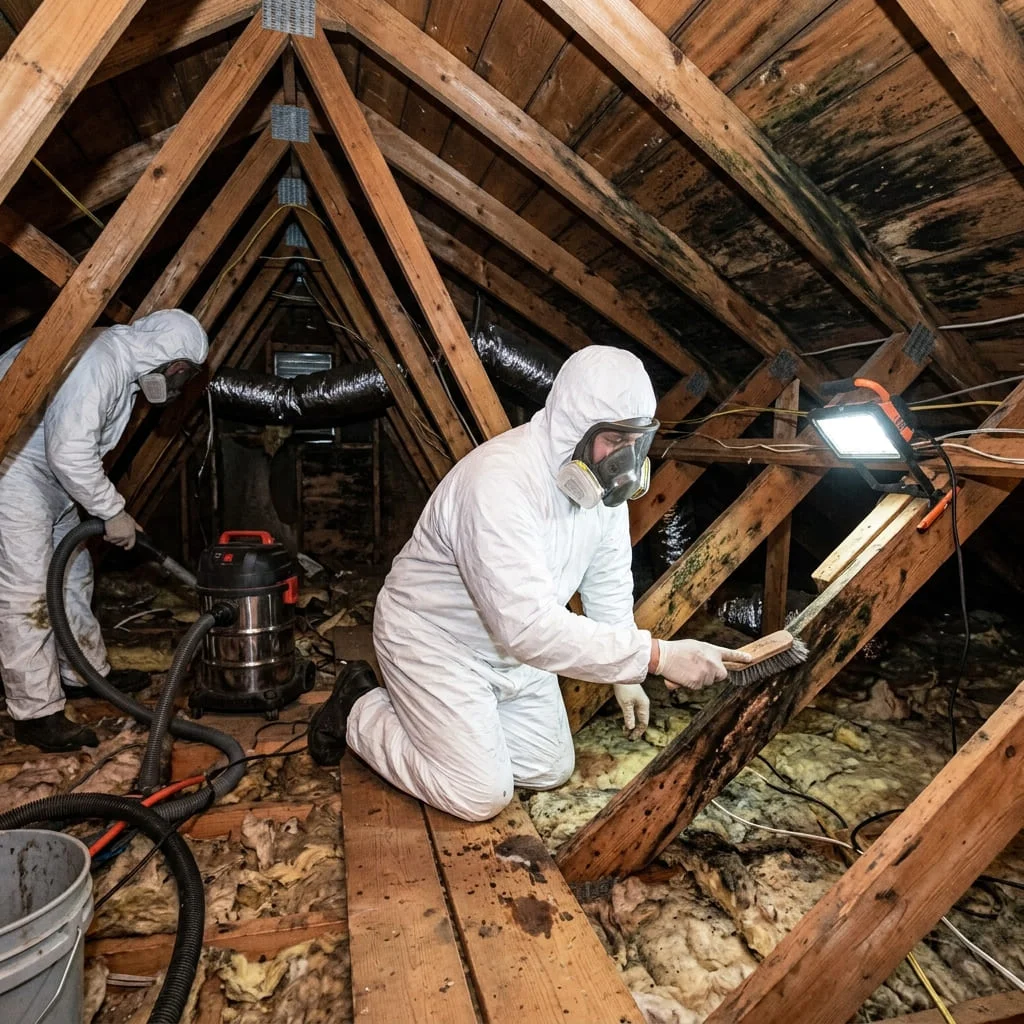
The attic is also where the cooling system lives, and that is the second risk. Sun City West homes typically run refrigerated air with the air handler and long duct runs in the attic, where summer temperatures are extreme. Cold supply air moving through ducts in that heat produces condensation wherever insulation has slumped, a joint has separated, or flex duct has been crushed or kinked — and the condensate drain pan and line at the air handler add another failure point that empties directly into the ceiling assembly when it clogs.
Plumbing from this build era deserves its own look. The late 1970s through the mid 1990s was the period when polybutylene supply piping was widely installed in American homes before it fell out of use, so it is genuinely worth identifying what your home was plumbed with rather than assuming. Whatever the material, original supply lines and original water heaters in this age range are at the stage where they seep at fittings rather than fail dramatically — and a garage water heater that weeps into a shared wall will feed mold remediation work in the room on the other side long before anyone notices a puddle.
The third factor is occupancy, and in Sun City West it is a major one. A large share of homes here are seasonal, closed up when the owners head somewhere cooler and reopened months later. An unoccupied Arizona house with the cooling turned off or set very high becomes a warm, still, humid box, and any leak that starts in that window runs unattended for the entire summer.
Guest casitas, spare bedrooms, and bathrooms nobody uses compound it. Traps in unused bathrooms dry out, rooms with the doors closed get no air movement, and the parts of the house with the highest mold risk end up being the parts with the fewest visits. If your home sits empty for stretches, leaving the cooling on at a moderate setpoint, fitting a leak detection and automatic shutoff device at the main, and arranging periodic in-person checks are all far cheaper than the water damage restoration and black mold removal that a four-month leak produces.
The single most useful thing to understand about a Sun City West home is that the tile roof and the waterproofing are two different systems with two very different lifespans. The tile is the wear surface — it takes the sun, the hail, and the foot traffic, and it can easily last the life of the house. Underneath it, a layer of underlayment is doing the actual waterproofing, and that layer is typically rated in the twenty-to-thirty-year range. On a home built in 1985, an original roof means original underlayment that is now decades past its intended service life, even though the roof looks fine from the street.
This matters for mold because underlayment does not fail all at once. It goes brittle and cracks gradually, letting small amounts of water past during each storm — not enough to drip through a ceiling, but plenty to keep attic sheathing and framing damp on a recurring basis through every monsoon season. By the time a stain appears on a hallway ceiling, the growth in the attic above it has usually been developing for several years. That is why an attic inspection with moisture readings tells you far more here than looking at the ceiling does.
When you compare contractors, ask specifically whether their inspection includes the attic and the underside of the roof deck, and whether their scope distinguishes roof-sourced moisture from HVAC condensation — the two look similar from below but call for completely different corrections. A crew that remediates attic mold without identifying which one caused it is selling you the same job again next July. Arizona Mold Pros can help you get matched with a specialist covering Sun City West; nearby you can also compare mold removal companies in Sun City and Wittmann.
A ceiling stain appearing in a hallway or interior room after monsoon rain, with no obvious damage visible from the street, points to tile underlayment failure tracking water along the roof deck rather than a problem with the tile itself.
Condensation or drip marks near the attic air handler or duct joints, or a stained ceiling below a clogged condensate pan, are common signs of HVAC-related moisture in this age of home rather than a roof leak.
A musty smell in a guest room or bathroom that sits unused for stretches — common in seasonal Sun City West homes — is worth checking first upon returning, since unused traps dry out and closed rooms get no air movement.
Expect the inspector to check the attic and roof deck condition specifically, since underlayment failure — not the tile itself — is the usual point of entry at this home age.
Expect the contractor to distinguish roof-sourced moisture from HVAC condensation before proposing a fix, since the two look similar from below but call for different corrections.
If your home is seasonal, expect the contractor to ask how long it has sat vacant, since that changes how extensive the problem is likely to be.
Mold remediation is one of the few home services where the homeowner carries most of the verification burden. These four checks apply to every contractor on this page, and they are worth running before you sign anything.
Arizona does not issue a license specifically for mold remediation. Crews generally work under an Arizona Registrar of Contractors (ROC) license instead, which means verifying a contractor's ROC status and insurance is on the homeowner rather than on the state.
Check a license at the Arizona ROC →EPA guidance suggests that mold covering roughly more than 10 square feet is generally beyond a do-it-yourself cleanup and warrants professional remediation. Smaller patches can often be handled yourself — provided you have also fixed the moisture source feeding them.
EPA mold cleanup guidance →The ANSI/IICRC S520 standard is the widely recognized standard of care for professional mold remediation, covering containment, worker protection, and verification. A contractor who can tell you how their scope maps to it is giving you something you can hold them to.
Post-remediation verification confirms the work succeeded. Where the budget allows, have it performed by someone independent of the company that did the removal, so the party certifying the result is not the party being paid for it.
How this guide works. Arizona Mold Pros is a directory — we are not the remediation contractor and we do not perform the work ourselves. Listings are compiled from publicly available information about companies advertising mold services in the Sun City West area, and ratings and review counts are approximate figures gathered from public sources that change over time, so verify them yourself before hiring. We may be compensated when a homeowner connects with a contractor through this site. That does not change the evaluation criteria above, and we recommend comparing at least three written scopes regardless of who you call.
Yes, and it is one of the most common causes here. The tiles are the wear surface, but the underlayment beneath them does the waterproofing, and felt underlayment generally has a service life of about twenty to thirty years. On homes built from 1978 into the late 1990s that layer is often original and long past its intended life, letting small amounts of water past during each storm while the roof still looks perfect from the street.
Sun City West homes typically have the air handler and long duct runs in the attic, where summer temperatures are extreme. Cold supply air moving through that heat produces condensation anywhere insulation has slumped, a joint has separated, or flex duct has been crushed. The condensate drain pan and line add another failure point, because a clogged line empties straight into the ceiling assembly below.
Original supply lines and original water heaters from that era are now at the stage where they seep at fittings rather than fail dramatically, which is exactly the slow hidden moisture that feeds mold inside walls. The late 1970s through mid 1990s was also the period when polybutylene supply piping was widely installed before falling out of use, so it is worth identifying what your home was actually plumbed with rather than assuming.
Costs run the usual $1,500-to-$10,000-plus range. A job tied to failed tile roof underlayment may also need a roofer alongside the mold contractor, since remediating attic mold under a roof that still leaks means paying for the work twice.
Most jobs take 1 to 5 days. If a roof repair needs to happen first, confirm that timeline separately rather than assuming the mold work can start immediately.
A sudden pipe failure is usually covered like anywhere else, but a roof underlayment failure that developed gradually over 20-plus years reads more like deferred maintenance to an insurer than a covered sudden event — a documented roof inspection report helps establish what actually happened.
It shows up most often from tile roof underlayment reaching the end of its service life, or from attic ductwork condensation where insulation has slumped or a condensate line has clogged.
If the affected area is the attic or roof cavity, most residents can stay home, since the work happens above the ceiling rather than in living space. A larger job reaching multiple rooms is more likely to call for temporary relocation.
Have your roof's underlayment condition assessed rather than just checking for cracked tiles, especially once the roof passes twenty years old. Confirm the AC condensate pan's float switch actually works, and identify what your home was plumbed with if you're unsure — polybutylene supply lines were common in this era and are worth knowing about.
Don't wait for mold to spread. Compare the top-rated mold removal contractors serving Sun City West and the surrounding area. Get your free estimate today — no obligation, no pressure.
Call Now for Free QuotesFree estimates · No obligation · Licensed contractors