Paul Davis Restoration of Southern Arizona
Full-service restoration franchise covering southern Arizona, offering mold remediation, water and fire damage repair, and reconstruction under one contract.
Compare ratings, reviews, and services from the best mold remediation contractors serving Vail and the surrounding area — then get matched with a free, no-obligation quote.
Comparing top-rated mold removal companies serving Vail, ArizonaVail sits higher than Tucson, and that single geographic fact drives most of what makes mold different here. The Rincon Valley climbs toward the Rincon Mountains to the north and the Santa Rita and Whetstone ranges to the south and east, and higher ground in southern Arizona means more rainfall, not less. Monsoon storms that break up over the city can still be producing hard over Vail, and the community runs wetter than the Tucson basin.
Vail also has something almost no other Arizona community has: a perennial stream. Cienega Creek and the Davidson Canyon drainage run year-round in stretches through the Cienega Creek Natural Preserve, supporting a genuine riparian corridor with a shallow water table alongside it. Ground near a perennial creek behaves nothing like open desert, and homes built near those washes and drainages face moisture conditions a standard Tucson inspection checklist would not think to look for.
Add rapid growth — Rancho del Lago, the Rita Ranch corridor, and the newer subdivisions along I-10 have filled in quickly — plus a large number of unincorporated Pima County properties on private wells and septic systems, and Vail ends up with an unusually wide range of mold triggers for one community. Arizona Mold Pros compared the mold removal companies that cover the Rincon Valley so you can weigh coverage and response time in one place. Start with mold inspection and testing, or with water damage restoration if water has already come in.
Last Updated: July 2026
Every company listed below is evaluated on customer reviews, Google ratings, licensing and insurance status, response time and availability, the range of mold services offered, and experience with Arizona-specific mold issues like monsoon moisture and swamp cooler condensation. We only feature companies that actively serve the Vail area.
Verified Google ratings and the volume and consistency of homeowner reviews.
Companies that carry the licensing and insurance Arizona homeowners should expect.
How quickly a company can be on site — including 24/7 emergency coverage.
Inspection, testing, remediation, and water damage restoration under one roof.
Familiarity with monsoon moisture, swamp cooler condensation, and desert construction.
Only companies that actively serve the Vail area make our list.
Full-service restoration franchise covering southern Arizona, offering mold remediation, water and fire damage repair, and reconstruction under one contract.
Mold, water, and fire damage restoration franchise offering inspection, containment, removal, and reconstruction for Tucson-area homes and businesses.
Tucson-based restoration contractor specializing in mold remediation, moisture mapping, and structural drying, with independent testing available on request.
Southern Arizona restoration company handling mold removal, water extraction, and repairs for homes across the Tucson and Santa Cruz Valley area.
Neighborly-affiliated restoration franchise handling mold remediation, water damage mitigation, and odor removal for residential and light commercial properties.
| Service | Average Cost Range |
|---|---|
| Mold Inspection | $300 – $600 |
| Small Area Remediation (under 50 sq ft) | $1,500 – $3,500 |
| Medium Remediation (50–200 sq ft) | $3,500 – $6,000 |
| Full Home Remediation (200+ sq ft) | $5,000 – $10,000 |
| Attic Mold Removal | $2,000 – $6,000 |
| Crawl Space Mold Removal | $2,500 – $7,000 |
| Black Mold Removal | $3,000 – $8,000 |
| Commercial Mold Remediation | $5,000 – $25,000+ |
Costs in Vail can vary depending on the size of the affected area, type of mold, accessibility, and whether structural repairs are needed. Arizona's dry climate means mold often concentrates around specific moisture sources — monsoon water intrusion, swamp cooler leaks, or plumbing failures — rather than spreading across entire homes. We recommend getting at least 3 quotes from licensed contractors to compare pricing.
Compare free quotes from top Vail mold removal companiesElevation and rainfall come first. Vail sits meaningfully above the Tucson basin, and in southern Arizona elevation buys you moisture — more monsoon rain, more winter storm precipitation, cooler nights, and longer drying times after a storm than a home down in the valley would see. A roof detail that has held up fine for twenty years in central Tucson can be receiving noticeably more water per season out here, and roof underlayment, valley flashing, and penetration sealant age against the amount of water they actually shed rather than against the calendar.
Cooler overnight temperatures matter too, because condensation is a temperature problem before it is a humidity problem. Cold supply ducts crossing a hot attic sweat when warm humid air meets cold metal, and in shoulder seasons a Vail attic can cycle through a wider temperature range in twenty-four hours than a home closer to the city. Anywhere the duct insulation has slumped, torn, or been pulled aside by a trade working in the attic becomes a slow drip onto drywall — the standard path to attic mold removal here.
The second factor is the water that does not go away. Cienega Creek runs perennially through parts of the preserve southeast of town, and along with Davidson Canyon it supports one of the few genuine riparian corridors in the region. A shallow water table and dense streamside vegetation mean the ground near those drainages holds moisture year-round rather than drying between storms, and homes on lots that back onto a wash or sit low relative to a drainage inherit that condition.
Monsoon flow makes the same corridors dangerous in the other direction. The washes that are quiet nine months of the year move serious water during a storm, and in the Rincon Valley the runoff coming off higher ground arrives fast. Water that enters at grade shows up at the bottom of a wall — softened baseboard, bubbling paint low on the drywall, efflorescence on block, flooring lifting along an exterior edge — rather than as a ceiling stain. Lots here vary widely in size, grading, and drainage, so two properties on the same road can see completely different outcomes from one storm.
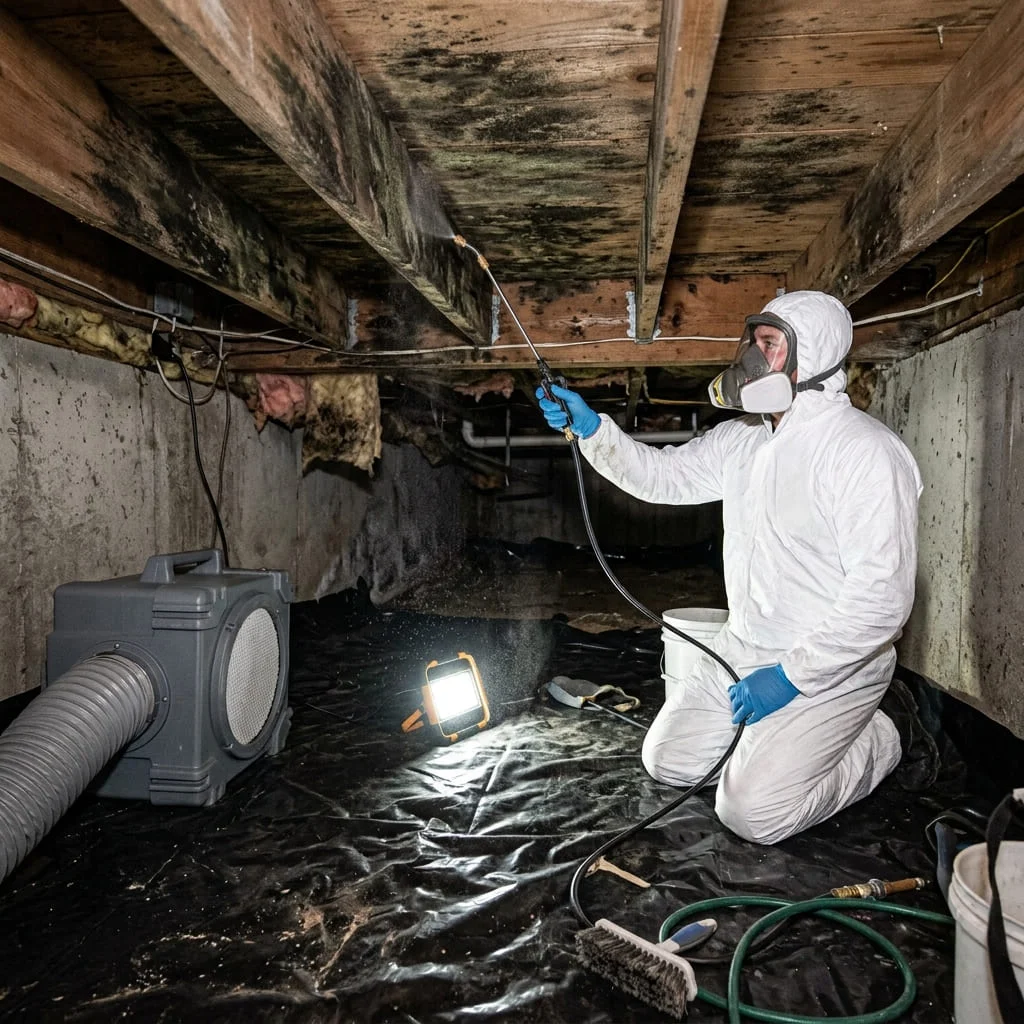
Third is the character of the properties themselves. Much of the Vail area is unincorporated Pima County, and a large number of homes run on private wells and septic systems rather than municipal utilities. That adds an entire category of moisture sources a suburban inspection never opens: pressure tanks and pump houses that corrode and weep, buried supply lines that leak underground for months, and leach fields that stay saturated close to the house. Older rural properties and manufactured homes add a further one — water trapped in a skirted underfloor cavity beneath the belly wrap, sitting against subfloor sheathing with no way to dry, which is exactly the situation crawl space mold removal exists to handle.
The newer side of Vail has the opposite profile. Rancho del Lago, the Rita Ranch corridor, and the recent subdivisions along I-10 are tight, well-sealed, slab-on-grade homes where the failures are installation defects rather than wear: an unsealed shower pan, window flashing lapped the wrong way, a condensate line draining into a wall bay. A sealed envelope holds that moisture in rather than letting it dry, so a house only a few years old can need full mold remediation behind a shower wall with no visible warning.
If your Vail home runs on a private well and septic system, a standard city-water inspection checklist will miss roughly half the moisture sources on your property. Tell the contractor about your setup when you book, and ask them to allow extra time for it — an inspector who arrives expecting a suburban tract home and a meter at the curb will not have budgeted for a pump house and a leach field.
The well side has three things worth walking before anyone arrives. Check the pressure tank and any pump house enclosure for corrosion, mineral staining, or a damp ring at the base, because a fitting that weeps a few drops an hour is invisible and never stops. Follow the supply line from wherever it enters the house and look at the drywall low on that wall for softening, bubbling, or discoloration. And note whether any part of the yard stays green, soft, or oddly cool underfoot when the rest is dry — persistent saturation over a buried line or near a leach field is a moisture report worth handing to an inspector.
The septic side is simpler but easy to skip: note where the tank and field are, whether the ground above them holds water after a storm, and whether there is any odor or unusually vigorous vegetation close to the house. A leach field saturating toward a foundation is not a plumbing problem you will see from inside, and it will keep feeding whatever is growing at a slab edge no matter how carefully the drywall is replaced.
If your lot backs onto a wash or sits low relative to a drainage, add the perimeter to the list. Look for a high-water line on block walls or the stucco, check that the grade still falls away from the foundation on every side, and look at where water actually pooled during the last storm rather than where you assume it goes. In the Rincon Valley the runoff from higher ground arrives quickly, and the difference between a wet patio and a wet living room is often a couple of inches of grade at one corner of the house.
On the work itself, the questions are the same as anywhere: containment and HEPA filtration established before demolition begins, a stated removal margin beyond the visible growth, and dryness verified with a moisture meter and recorded in a drying log rather than judged by hand. For anything larger than a small contained area, have post-remediation verification done by someone independent of the firm that performed the removal. Arizona Mold Pros can connect you with a licensed contractor serving the Vail area — compare mold removal companies in Sahuarita, Green Valley, and Marana alongside this page, browse all service areas, or get in touch.
The most obvious sign is visible growth — black, green, or white spots spreading across walls and ceilings, under sinks, or around window frames. But mold in Vail homes often hides, so a persistent musty or earthy odor in a bathroom, closet, or other enclosed space is just as important to take seriously. That smell usually means moisture is feeding something you can't yet see.
Context matters too. If your Vail home has had recent water damage, flooding, or a plumbing leak, mold can begin growing within 24 to 48 hours. Watch for peeling paint, bubbling wallpaper, or discoloration on surfaces, and pay attention to condensation collecting on windows or walls. Unexplained respiratory symptoms, worsening allergies, or headaches that ease when you leave the house can also point to a hidden mold problem.
If you notice any of these signs in your Vail home, contact a licensed mold remediation professional for an inspection before the problem spreads.
A quality mold removal company in Vail starts with an inspection and assessment to identify the type of mold and the extent of the problem. Once the scope is clear, the crew contains the affected area with plastic sheeting and negative air pressure so spores don't spread to clean parts of the house, then runs HEPA air filtration to capture anything airborne.
From there, the actual remediation begins: physical removal of mold using antimicrobial treatments and scrubbing, followed by thorough drying and dehumidification of the affected areas. Any damaged materials — drywall, insulation, or flooring — are repaired or replaced, and reputable contractors finish with post-remediation testing to confirm mold levels are back to normal.
The best mold removal companies serving Vail will provide a detailed scope of work and walk you through each step before starting any remediation.
Mold remediation is one of the few home services where the homeowner carries most of the verification burden. These four checks apply to every contractor on this page, and they are worth running before you sign anything.
Arizona does not issue a license specifically for mold remediation. Crews generally work under an Arizona Registrar of Contractors (ROC) license instead, which means verifying a contractor's ROC status and insurance is on the homeowner rather than on the state.
Check a license at the Arizona ROC →EPA guidance suggests that mold covering roughly more than 10 square feet is generally beyond a do-it-yourself cleanup and warrants professional remediation. Smaller patches can often be handled yourself — provided you have also fixed the moisture source feeding them.
EPA mold cleanup guidance →The ANSI/IICRC S520 standard is the widely recognized standard of care for professional mold remediation, covering containment, worker protection, and verification. A contractor who can tell you how their scope maps to it is giving you something you can hold them to.
Post-remediation verification confirms the work succeeded. Where the budget allows, have it performed by someone independent of the company that did the removal, so the party certifying the result is not the party being paid for it.
How this guide works. Arizona Mold Pros is a directory — we are not the remediation contractor and we do not perform the work ourselves. Listings are compiled from publicly available information about companies advertising mold services in the Vail area, and ratings and review counts are approximate figures gathered from public sources that change over time, so verify them yourself before hiring. We may be compensated when a homeowner connects with a contractor through this site. That does not change the evaluation criteria above, and we recommend comparing at least three written scopes regardless of who you call.
Yes on both counts. Vail sits higher than the Tucson basin in the Rincon Valley, and in southern Arizona greater elevation generally means more monsoon and winter storm precipitation along with cooler nights and slower drying after a storm. More water per season ages roof underlayment, valley flashing, and penetration sealant faster than the calendar would suggest, and wider overnight temperature swings make attic duct condensation more likely.
They can. Cienega Creek and the Davidson Canyon drainage run perennially in stretches and support a genuine riparian corridor, which means a shallow water table and ground that holds moisture year-round rather than drying between storms. Homes on lots backing onto a wash or sitting low relative to a drainage tend to see moisture arrive at grade, so the signs appear at the bottom of a wall — softened baseboard, efflorescence on block, or flooring lifting along an exterior edge.
The remediation work is identical, but the investigation should be considerably broader. An inspector should include the pressure tank, the pump house, the route of the buried supply line, and any part of the leach field that stays saturated near the house, because those are moisture sources a standard municipal-water inspection would never open. Mention your setup when you book so the contractor allows enough time on site.
Mold removal costs in Vail typically range from $1,500 for small areas to $10,000 or more for full-home remediation. The exact cost depends on the size of the affected area, type of mold, and whether structural repairs are needed. We recommend getting at least 3 quotes from licensed contractors.
Most residential mold remediation jobs in Vail take 1 to 5 days. Larger projects involving multiple rooms, extensive water damage, or structural repairs can take up to 2 weeks. Your contractor should provide a timeline before work begins.
It depends on the cause. Arizona homeowners insurance typically covers mold remediation if the mold resulted from a sudden, accidental event like a burst pipe or storm damage. Mold caused by ongoing neglect, deferred maintenance, or pre-existing conditions is usually not covered. Check with your insurance provider for specifics.
Yes. Despite Arizona's dry climate, black mold (Stachybotrys chartarum) can develop anywhere with persistent moisture — bathrooms, attics, crawl spaces, and behind walls near plumbing. Monsoon season, swamp coolers, and water heater failures are common causes of black mold growth in Vail homes.
It depends on the severity. For small, contained areas, you can usually stay home while the remediation crew works. For larger projects involving multiple rooms or HVAC system contamination, temporary relocation may be recommended — especially for households with children, elderly family members, or anyone with respiratory conditions.
Fix the moisture source first — that's the number one priority. After that, improve ventilation in bathrooms and kitchens, use exhaust fans, consider a dehumidifier for enclosed spaces, and schedule regular inspections especially before and after monsoon season (July through September). In Vail, pay extra attention to swamp cooler areas and any rooms adjacent to exterior plumbing.
Don't wait for mold to spread. Compare the top-rated mold removal contractors serving Vail and the surrounding area. Get your free estimate today — no obligation, no pressure.
Call Now for Free QuotesFree estimates · No obligation · Licensed contractors