SERVPRO of Tucson Valley
Locally owned franchise of the national restoration brand, handling mold remediation and water damage across the Tucson valley.
Services Tucson and the surrounding area
Compare ratings, reviews, and services from the best mold remediation contractors serving Tucson and the surrounding area — then get matched with a free, no-obligation quote.
 Comparing top-rated mold removal companies serving Tucson, Arizona
Tucson gets meaningfully more rain than Phoenix — roughly eleven to twelve inches in an average year against the low sevens up north — and most of it arrives in the summer monsoon. It sits about 2,400 feet above sea level, so storms build harder over the Catalinas and the Rincons and come down the bajada fast. For a homeowner, the practical translation is simple: there are more actual water events here per year, and a roof or a wall that would get away with a weak detail in the Valley does not get away with it in Tucson.
The second difference is what Tucson houses are made of. Tucson has been continuously settled far longer than Phoenix, and its historic core — Barrio Viejo, Armory Park, El Presidio, Dunbar Spring, Sam Hughes — is full of mud adobe and burnt adobe buildings with flat roofs, parapet walls, and canales, a construction system that handles water in a way no stucco-over-frame tract home does. Arizona Mold Pros compared the mold removal companies working Tucson and Pima County so you can weigh coverage and response in one place. Start with mold inspection and testing if you are chasing a smell or a stain, or water damage restoration if water is coming in now.
Last Updated: September 2026
The companies below serve the Tucson area. We do not rank them, rate them, or verify their credentials on your behalf — that check is yours to make, and the steps below are the ones worth making it with. Arizona issues no mold-specific license, so the burden of confirming a contractor's licensing, insurance, and scope of work sits with the homeowner.
Arizona issues no mold-specific license, so crews work under a Registrar of Contractors license. Ask for the number and look it up — status, classification, and complaint history are all public.
Request a certificate of liability insurance naming you, sent directly from the insurer or agent rather than a copy from the contractor.
A written scope should name the moisture source, the containment method, what gets removed versus dried, and how completion will be confirmed.
Prices for the same job vary widely. Three written quotes tell you whether an outlier is thorough or simply expensive.
Remediation before the leak is repaired means paying for the same work twice. Any quote silent on the source is incomplete.
For anything past a small area, have post-remediation verification done by someone other than the company that did the removal in Tucson.
Locally owned franchise of the national restoration brand, handling mold remediation and water damage across the Tucson valley.
Full-service restoration franchise covering southern Arizona, offering mold remediation, water and fire damage repair, and reconstruction under one contract.
Emergency-focused franchise handling mold removal and water damage response across the Tucson area.
Franchise territory covering the northwest corridor — Marana, Avra Valley, Oro Valley, and Casas Adobes — for mold remediation, water extraction, and post-storm structural drying.
Neighborly-affiliated restoration franchise handling mold remediation, water damage mitigation, and odor removal for residential and light commercial properties.
| Service | Average Cost Range |
|---|---|
| Mold Inspection | $300 – $600 |
| Small Area Remediation (under 50 sq ft) | $1,500 – $3,500 |
| Medium Remediation (50–200 sq ft) | $3,500 – $6,000 |
| Full Home Remediation (200+ sq ft) | $5,000 – $10,000 |
| Attic Mold Removal | $2,000 – $6,000 |
| Crawl Space Mold Removal | $2,500 – $7,000 |
| Black Mold Removal | $3,000 – $8,000 |
| Commercial Mold Remediation | $5,000 – $25,000+ |
Costs in Tucson can vary depending on the size of the affected area, type of mold, accessibility, and whether structural repairs are needed. Arizona's dry climate means mold often concentrates around specific moisture sources — monsoon water intrusion, swamp cooler leaks, or plumbing failures — rather than spreading across entire homes. We recommend getting at least 3 quotes from licensed contractors to compare pricing.
Get free quotes from top Tucson mold removal companiesFlat roofs are the first Tucson risk, and they are everywhere — not only on historic adobes but on midcentury modern homes across the central city and in the foothills. A flat or low-slope roof does not shed a storm; it holds it, and everything depends on details that fail quietly. Parapet walls are the usual weak point: the cap on top of the parapet takes sun and rain from every direction, and once it cracks, water runs down inside the wall rather than off the roof, showing up at the top of an interior wall well away from the entry point.
Canales — the scuppers that drain water through the parapet to the outside — are the other. A canale that is undersized, blocked with debris, or no longer sloped correctly backs water up onto the roof, and ponding is what turns a marginal roof into a wet ceiling. On a flat roof there is often no attic to crawl into and no vent path to dry the assembly out, so moisture can sit in the deck and insulation for a long time behind a ceiling that shows only a faint ring. Locating it usually takes infrared scanning or test cuts rather than a look through a hatch.
Adobe changes everything about how moisture behaves in a wall. Mud adobe is soil and straw, so it holds organic material and it wicks water readily; burnt adobe is fired, more durable, and still far more porous than fired brick. Both are mass walls, which means they take on water slowly, hold it, and release it slowly — and they sit on caliche soils, often with no capillary break at the base, so persistent wet ground shows up as rising damp a foot or two up the inside of the wall with plaster failing and salts crystallizing at the surface.
The mid-century habit of covering adobe with cement stucco made it worse. Cement plaster is far less permeable than the adobe behind it, so water that gets in through a roof leak, a cracked parapet, or the base of the wall cannot evaporate back out — it stays in the wall and works on plaster, wood lintels, and any framing tied into the masonry. Lime plaster, the traditional finish, breathes. If your Tucson home is adobe under cement stucco and you have soft or bubbling plaster near the base of a wall, that is a moisture-path problem and no amount of surface cleaning will end it.
Everything else that produces mold calls in Tucson runs through those two systems. Evaporative cooling is still widely used here, and a cooler adds humidity by design, which is a genuine load on a house whose walls dry slowly. Monsoon storms drop sheet flow down the bajada onto lots where the grade was set decades ago, and the dry washes threading the city — the Rillito, the Pantano, the Santa Cruz — carry real water a few times a summer and back it into low-lying property. Slab-on-grade homes on the east side and in Oro Valley's direction have the same buried weep screed and tile underlayment problems as any 1990s subdivision in the state.
Then there is the rental market around the University of Arizona, where a large share of housing turns over annually. A tenant with four months left on a lease has little reason to chase a slow bathroom leak, and an off-site owner has no way to see it, so by the time a unit turns over and someone looks behind the vanity, the wall cavity has been wet for a semester. In older multifamily buildings with shared plumbing stacks, one unit's leak becomes the neighbor's problem — usually a multi-unit remediation rather than a simple single-family job.
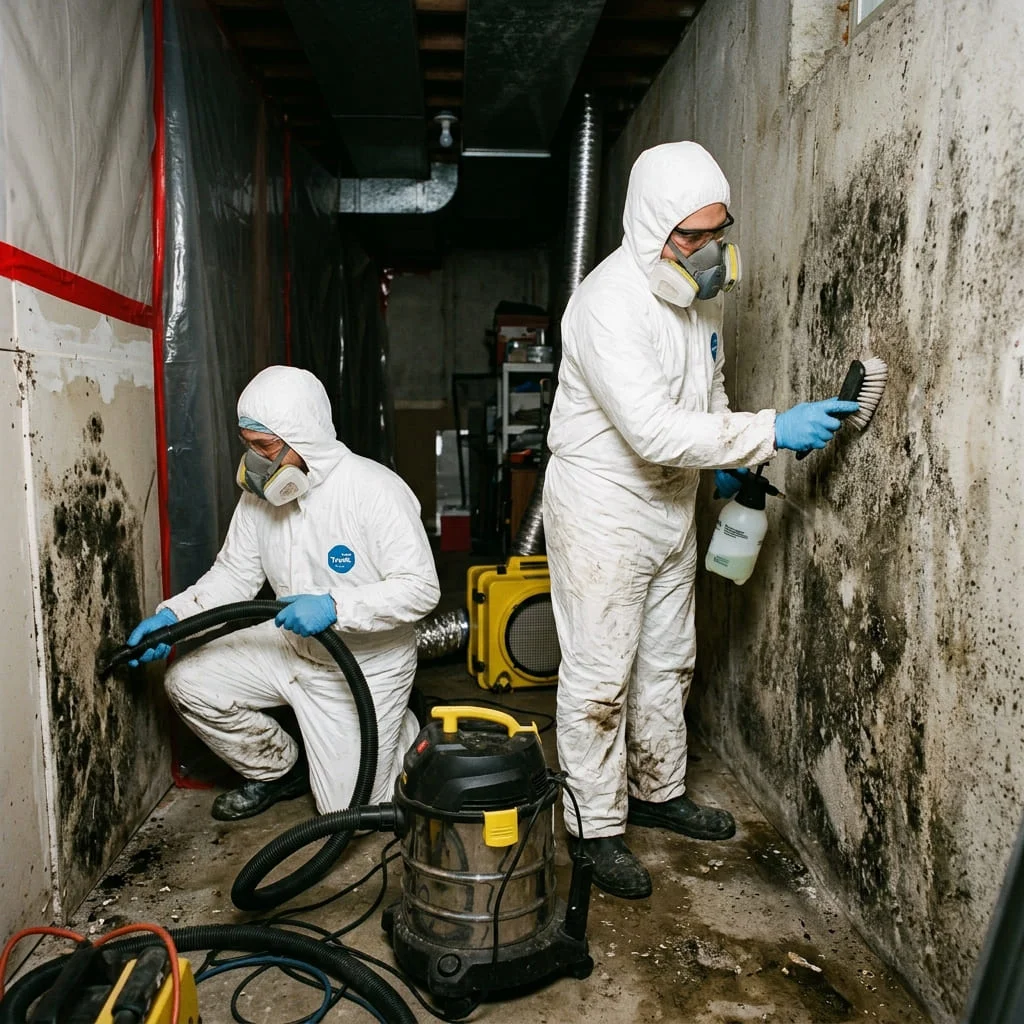
Remediation in a masonry house is not the same job as remediation in a drywall house, and hiring someone who treats it as one is the most expensive mistake available in the Tucson historic districts. Four things change.
Measurement changes. The pin-type moisture meter used on wood and drywall tells you very little about a mass adobe wall. Masonry needs non-invasive meters and, where it matters, deeper probes, read against a dry reference area of the same wall — a single number means nothing without something to compare it to. Ask how the inspector intends to measure moisture in adobe before you book, because an inspector who only has one tool will report on the plaster rather than the wall.
Removal changes. You cannot cut out two feet of adobe wall and screw in a new sheet the way you would with drywall. Remediation in these houses concentrates on the finishes and the wood — failed plaster, baseboards, flooring, wood lintels, vigas, latillas, and any framing tied into masonry — and on drying the wall itself, which happens on a timescale of weeks rather than days because a mass wall gives up water slowly. A contractor promising to have an adobe wall dry by Thursday is describing the plaster, not the adobe.
The repair specification changes. If cement stucco is trapping moisture in the wall, replacing it with more cement stucco reproduces the problem. The traditional finish is lime plaster, which is vapor-permeable and lets the wall dry outward. Likewise, the moisture path has to be closed first: the parapet cap, the canale, the roof membrane, or the grade at the base of the wall. Drying and replastering under a cracked parapet is money spent twice.
The permitting picture changes. The City of Tucson has designated historic preservation zones covering Barrio Viejo, Armory Park, El Presidio, and other core neighborhoods, and exterior work on a property inside one generally goes through review. It does not govern what happens inside your walls, but it can affect roofing, plaster, windows, and anything visible from the street, so check with the city's planning office before locking in an exterior scope — and factor the timeline into an emergency repair rather than discovering it midway.
One last note that applies to any Tucson house, adobe or not. Because the walls and roof assemblies here dry slowly, post-remediation verification matters more than it does in a frame house that dries in a day. Ask for clearance testing by someone other than the company that did the removal, and ask to see the moisture readings that justified closing the wall up. Our guide to mold inspection versus remediation explains why those two roles are best kept separate.
Arizona Mold Pros can connect you with a contractor covering Tucson. Compare mold removal companies in Marana, Vail, Sahuarita, and Green Valley alongside this page, browse all service areas, or get in touch.
A faint ring on a ceiling appearing some distance from any obvious roof damage, on a flat or parapet-roofed Tucson home, points to water tracking along the deck from a failed canale or cracked parapet cap rather than a leak directly overhead.
Soft or bubbling plaster low on the wall of an adobe or burnt adobe home, especially one covered in cement stucco, is a sign moisture is trapped in the masonry rather than drying out of it.
A slow leak reported late in a rental near the University of Arizona — because a tenant with months left on a lease has little reason to chase it — is a real and common source here, not a hypothetical.
Expect a masonry or adobe home to need non-invasive moisture meters and deeper probes rather than the standard pin-type meter used on wood and drywall.
Expect drying on a mass adobe wall to take weeks rather than days, and expect the remediation to concentrate on finishes and wood rather than cutting out sections of the wall itself.
For exterior work in a designated historic district, expect a review process through the city's planning office to factor into the timeline.
Mold remediation is one of the few home services where the homeowner carries most of the verification burden. These four checks apply to every contractor on this page, and they are worth running before you sign anything.
Arizona does not issue a license specifically for mold remediation. Crews generally work under an Arizona Registrar of Contractors (ROC) license instead, which means verifying a contractor's ROC status and insurance is on the homeowner rather than on the state.
Check a license at the Arizona ROC →EPA guidance suggests that mold covering roughly more than 10 square feet is generally beyond a do-it-yourself cleanup and warrants professional remediation. Smaller patches can often be handled yourself — provided you have also fixed the moisture source feeding them.
EPA mold cleanup guidance →The ANSI/IICRC S520 standard is the widely recognized standard of care for professional mold remediation, covering containment, worker protection, and verification. A contractor who can tell you how their scope maps to it is giving you something you can hold them to.
Post-remediation verification confirms the work succeeded. Where the budget allows, have it performed by someone independent of the company that did the removal, so the party certifying the result is not the party being paid for it.
How this guide works. Arizona Mold Pros is a directory — we are not the remediation contractor and we do not perform the work ourselves. Listings are compiled from publicly available information about companies advertising mold services in the Tucson area, and ratings and review counts are approximate figures gathered from public sources that change over time, so verify them yourself before hiring. We may be compensated when a homeowner connects with a contractor through this site. That does not change the evaluation criteria above, and we recommend comparing at least three written scopes regardless of who you call.
Tucson averages roughly eleven to twelve inches of rain a year against the low sevens in Phoenix, and a large share of it falls in summer monsoon storms. More rain events mean more chances for a marginal roof detail, a blocked canale, or a flat grade to put water somewhere it should not be, and Tucson also sits higher and cooler, so wet materials dry more slowly in winter than they would in the Valley. The climate is still dry overall — mold here is a water-intrusion problem, not a humidity problem.
Yes. Mud adobe contains soil and straw, so there is organic material in the wall itself, and both mud and burnt adobe are porous enough to take on and hold water. What usually produces visible growth is the finish and the framing rather than the earth: failed plaster, baseboards, flooring, and the wood lintels and vigas tied into the masonry. The complicating factor is cement stucco applied over adobe, which stops the wall drying outward and keeps whatever got in trapped inside.
For interior work, generally no. For exterior work, probably yes: the City of Tucson has historic preservation zones covering Barrio Viejo, Armory Park, El Presidio, and other core neighborhoods, and changes visible from the street — roofing, plaster, windows — typically go through review. Check with the city planning office before you commit to an exterior scope, and build the review time into the plan, because the moisture source on these houses is often the parapet, the canale, or the roof and that is exterior work.
Costs run the usual $1,500-to-$10,000-plus range for frame construction. On an adobe or burnt adobe home, reconstruction can cost more if breathable lime plaster needs to replace an earlier cement stucco repair, and drying itself takes longer given how slowly a mass wall releases water.
It shows up most often from a flat or parapet roof letting water track along the deck through a failed canale or cracked cap, from moisture trapped behind cement stucco on an adobe wall, or from a rental leak near the university that went unreported for a semester.
Clear canales and check parapet caps before monsoon season. Never seal an adobe or burnt adobe wall with cement stucco or an impermeable paint. Renters near the university should report any leak or smell in writing with a date the moment it's noticed.
Don't wait for mold to spread. Compare the top-rated mold removal contractors serving Tucson and the surrounding area. Get your free estimate today — no obligation, no pressure.
Call Now for Free QuotesFree estimates · No obligation · Licensed contractors