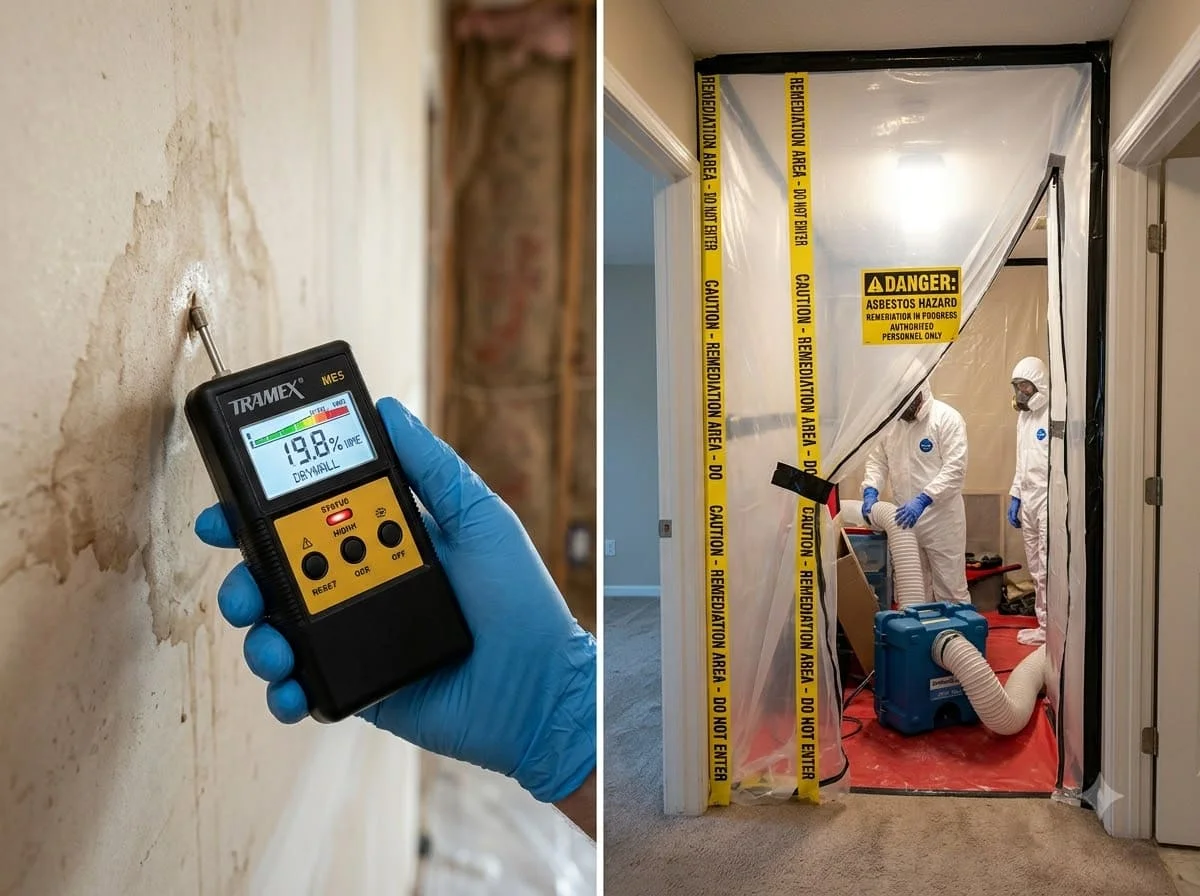
These two services get used interchangeably, and the confusion is expensive. One finds the problem and measures it. The other removes it. Mixing them up is how Arizona homeowners end up paying for remediation they did not need — or skipping the testing that would have proved the job was actually finished.
Here is what each service actually delivers, which one your situation calls for, what they cost in the Arizona market, and why the strongest arrangement usually keeps them with two different companies.
What Is a Mold Inspection?
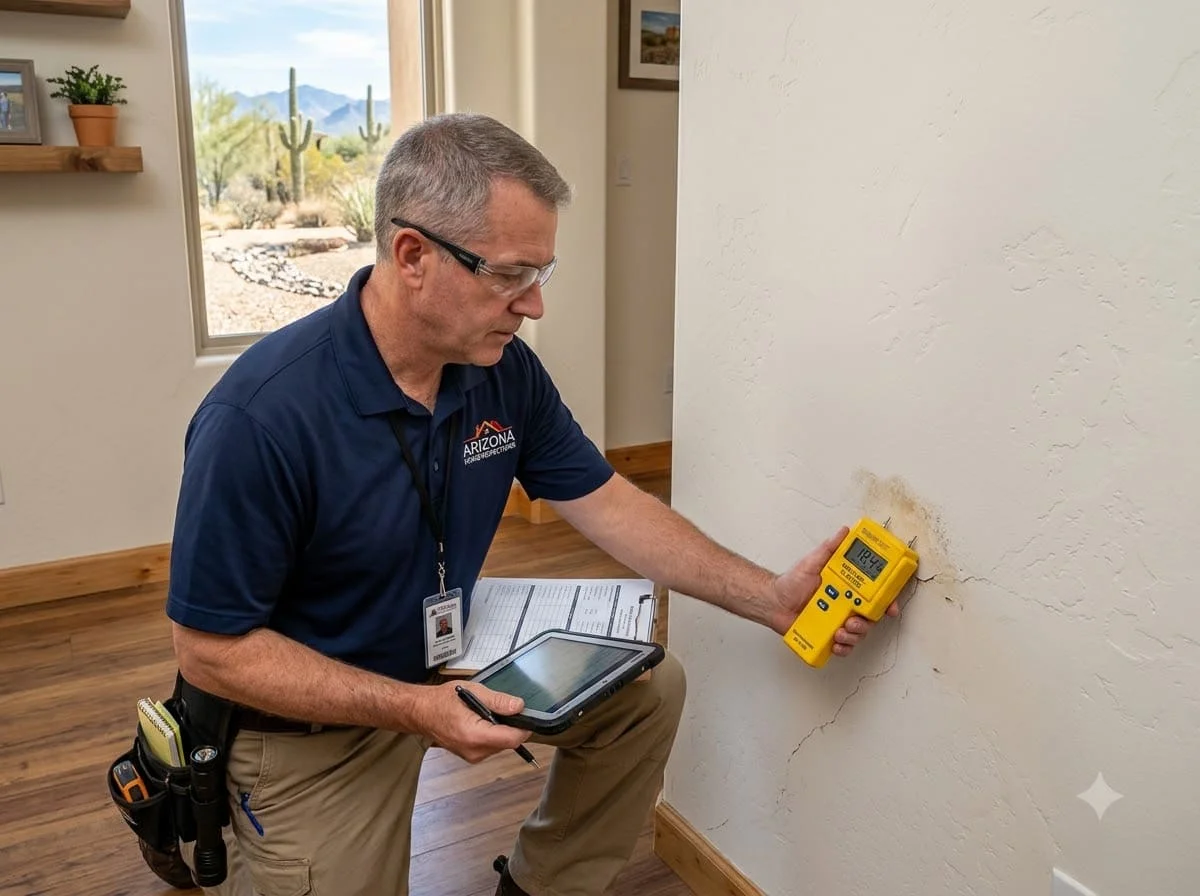 Inspector taking a moisture meter reading on a wall while assessing an Arizona home for mold
A mold inspection is diagnostic. Nothing gets removed and nothing gets cleaned. The deliverable is information: what is growing, how much of it there is, and — most importantly — what water is feeding it.
A thorough inspection includes:
- Visual assessment. Systematic examination of the areas mold favors in Arizona homes — under sinks, around water heaters, at attic ductwork, behind appliances, at window and door penetrations.
- Moisture mapping. Pin and pinless meters plus thermal imaging to read what surfaces do not show. This finds wet wall cavities and subfloor without cutting anything open, and it is the part of the inspection that actually earns the fee.
- Air sampling. Spore trap samples from affected areas, compared against an outdoor control sample. The outdoor baseline is essential — indoor counts mean nothing without something to compare them to.
- Surface sampling. Tape lifts or swabs of visible growth, sent to a lab for species identification.
- Written report. Findings, lab results, moisture readings, photos, and a recommended scope of work.
That written report is the real product. It converts a vague worry into a defined problem with boundaries — which is exactly what you need in hand before accepting a remediation quote, because it lets you compare bids against a fixed scope instead of against each contractor's own estimate of how bad things are.
What Is Mold Remediation?
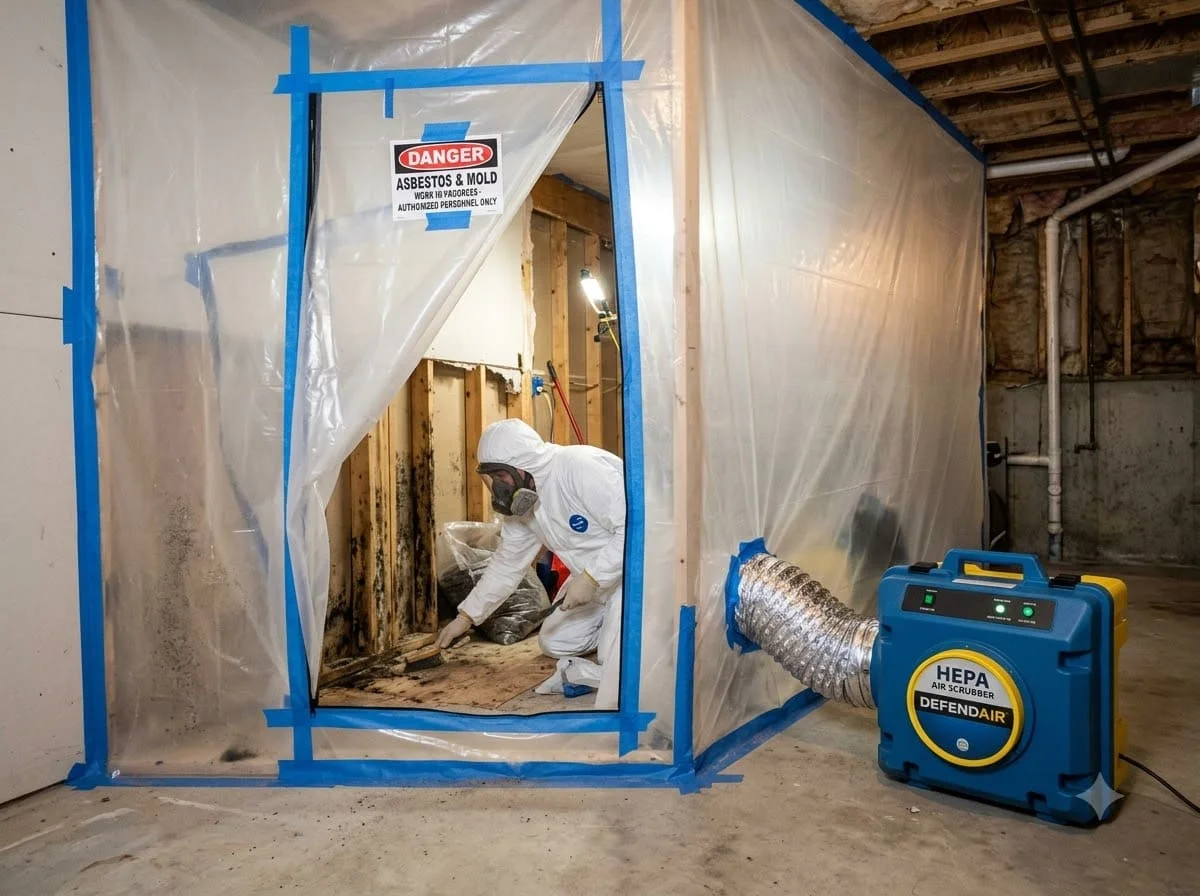 Sealed plastic containment with a HEPA air scrubber running during mold remediation in a home
Mold remediation is the physical work of removing growth and returning the affected area to normal condition. A contractor working to the ANSI/IICRC S520 standard follows a defined sequence:
- Containment. The work area is sealed with polyethylene sheeting, HVAC registers are closed off, and negative air pressure is established so air flows in and never out. Without this step, remediation spreads spores through the rest of the house.
- HEPA air filtration. Air scrubbers run throughout the work, capturing spores disturbed during removal.
- Removal. Porous material — drywall, insulation, carpet, pad, ceiling tile — is cut out and bagged, because porous material cannot be cleaned. Non-porous framing and hard surfaces are HEPA-vacuumed and cleaned in place.
- Antimicrobial treatment. Applied to remaining structural surfaces as a finishing step, never as a substitute for physical removal.
- Drying and source correction. Dehumidification brings the assembly back to normal moisture content, and the original water source is repaired. Skipping this guarantees the problem returns.
- Clearance verification. Post-remediation testing confirms spore counts have returned to normal before containment comes down.
How to read a cheap quote: containment and clearance testing are the two steps most often omitted to hit a lower number. A quote that jumps straight from "remove drywall" to "reinstall drywall" with no containment line item and no verification is describing cleaning, not remediation.
When You Need an Inspection Only
Several situations call for inspection with no removal work behind it:
- Buying a home. A standard Arizona home inspection is not a mold inspection and does not include moisture mapping or air sampling. On any property with past water damage, a swamp cooler, an aging flat roof, or a musty smell, a dedicated inspection before closing is cheap relative to what it can find.
- A musty smell with nothing visible. The classic Arizona case: a persistent odor in a closet or hallway with no stain anywhere. That smell almost always means moisture behind a surface, and moisture mapping is how you find it without opening walls at random.
- Post-remediation verification. Clearance testing after someone else's removal work. This is the strongest single use of an independent inspector.
- Health symptoms with no obvious cause. Respiratory symptoms that improve when the household leaves for a few days, with no visible growth to point at.
- After water damage that seemed handled. A follow-up moisture inspection two to three weeks after a leak catches wet cavities while they are still just wet.
- A second opinion on a large quote. If a remediation bid seems disproportionate to the problem, an independent inspection gives you an objective scope to compare it against.
When You Need Remediation
Sometimes the diagnosis is already obvious, and paying for an inspection first is spending money to confirm what you can see. Go straight to remediation when:
- Visible growth exceeds about 10 square feet. The EPA's residential guidance uses roughly a 3-by-3 patch as the point where homeowner cleanup stops being appropriate.
- Porous material is affected. Drywall, insulation, carpet, and ceiling tile cannot be cleaned — they come out regardless of area.
- Mold keeps returning to the same spot after cleaning, which means the moisture source was never corrected.
- The HVAC system is involved. Growth in ductwork or at the air handler distributes spores house-wide every time the system runs.
- Sewage or flood water was involved. Contamination extends well beyond mold, and this is never a DIY situation.
- Confined spaces are affected. Attics and crawl spaces combine poor access with poor airflow — crawl space mold removal is a clear example, since a crawl space holds ground moisture, plumbing runs, and effectively no air movement, and it will not resolve without containment and a vapor barrier.
When You Need Both
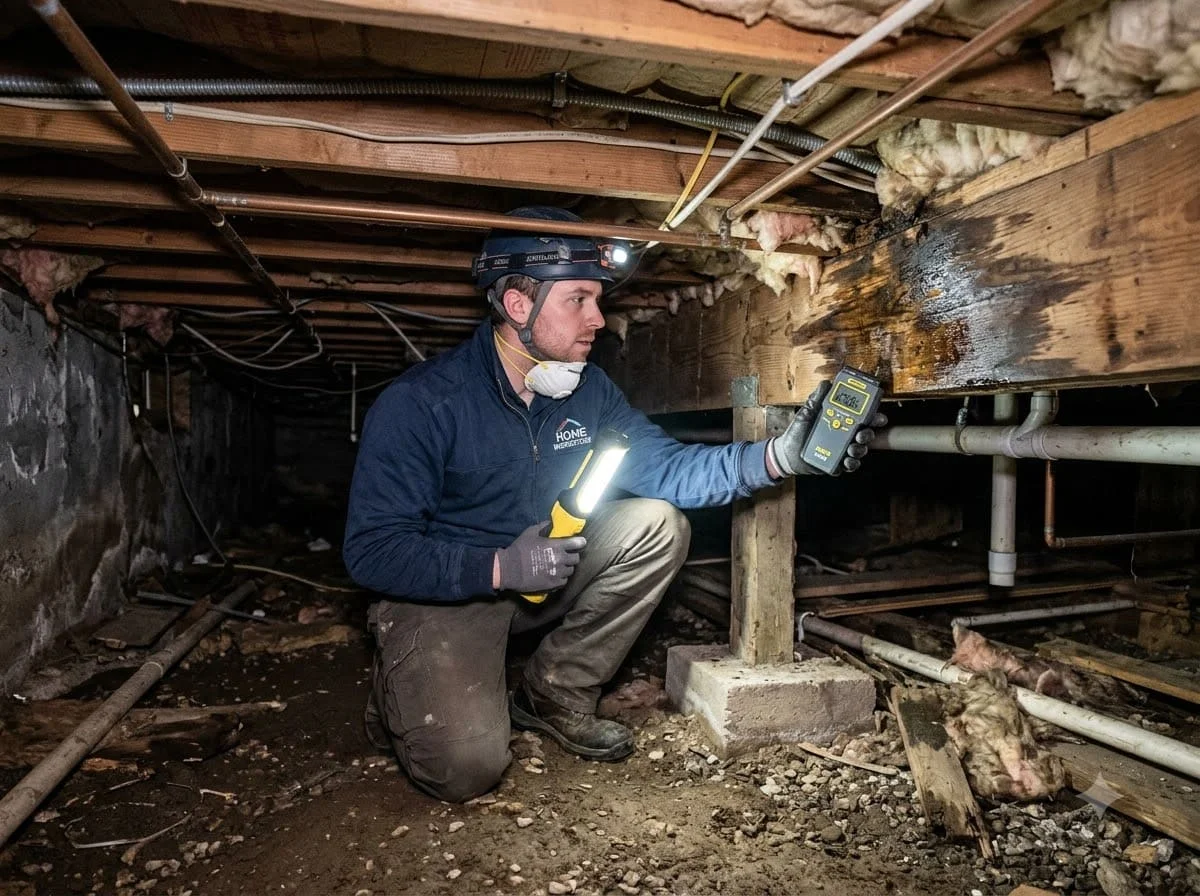 Technician inspecting a crawl space with a light and moisture meter beneath an Arizona home
This is the most common scenario, and it runs inspection → remediation → clearance test. The inspection defines the scope, the remediation executes it, and an independent clearance test confirms the work succeeded.
Which brings up the point most worth taking away from this article: the inspector and the remediation contractor should ideally be two different companies. A company that both diagnoses the problem and bills for solving it has a direct financial interest in finding more of it — and in certifying its own work as complete. That is not an accusation against any particular contractor; it is a structural conflict that exists regardless of anyone's intentions.
Be careful with "free mold inspections." When a remediation company offers free assessment, the assessment is a sales call. It may be perfectly honest, but it is not independent, and it produces no report you can use to compare bids. If you use a company that offers both services, at minimum have the post-remediation clearance test performed by a third party who did not do the removal.
The same logic applies to commercial properties, usually with more at stake. A commercial mold inspection typically has to account for occupant exposure, business interruption, and documentation for tenants or insurers — which makes an independent, defensible assessment more valuable, not less. Our full services overview covers how inspection, remediation, and restoration fit together across both residential and commercial work.
Cost Comparison in Arizona
These are general Arizona market ranges, not quotes. The number that matters is the written estimate a contractor gives you after seeing the property.
| Service | Typical Arizona range | What drives the number |
|---|---|---|
| Visual inspection + moisture mapping | $300 – $600 | Home size, crawl space or attic access, travel distance |
| Air sampling (per sample, lab included) | $100 – $200 | Most homes need 2–4 samples plus an outdoor baseline |
| Small remediation — one room or wall section | $1,500 – $3,500 | Square footage, how much porous material is removed |
| Mid-size remediation — multiple rooms | $3,500 – $7,000 | Containment complexity, material replacement, drying time |
| Large remediation — attic, HVAC, or whole-home | $7,000 – $10,000+ | Access difficulty, duct cleaning or replacement, reconstruction |
| Post-remediation clearance testing | $300 – $600 | Number of samples, independent third-party premium |
The factors that move an Arizona quote the most:
- Porous vs non-porous material. Cleaning tile is cheap; cutting out and replacing drywall, insulation, and flooring is where cost accumulates.
- Access. An attic in August or a tight crawl space costs more in labor than the same square footage in an open room.
- HVAC involvement. Duct cleaning or replacement can add thousands on its own.
- Reconstruction. Many quotes cover removal only — confirm whether drywall, paint, and flooring are included or a separate trade.
- Emergency scheduling. Same-day and after-hours response carries a premium, particularly during monsoon season when demand spikes across the Phoenix and Tucson metros.
Two notes on insurance. Many Arizona policies cap mold coverage at $5,000 to $10,000 even when the underlying water loss is covered, and mold traced to long-term seepage rather than a sudden event is typically excluded outright. Documenting the water source early is what determines which side of that line your claim falls on.
Arizona Mold Pros is a directory rather than an inspection or remediation company. We compare the contractors who perform this work on public ratings, licensing and insurance status, response time, and Arizona experience — including which ones offer inspection independently of removal. Call for free, no-obligation quotes from specialists serving your area.