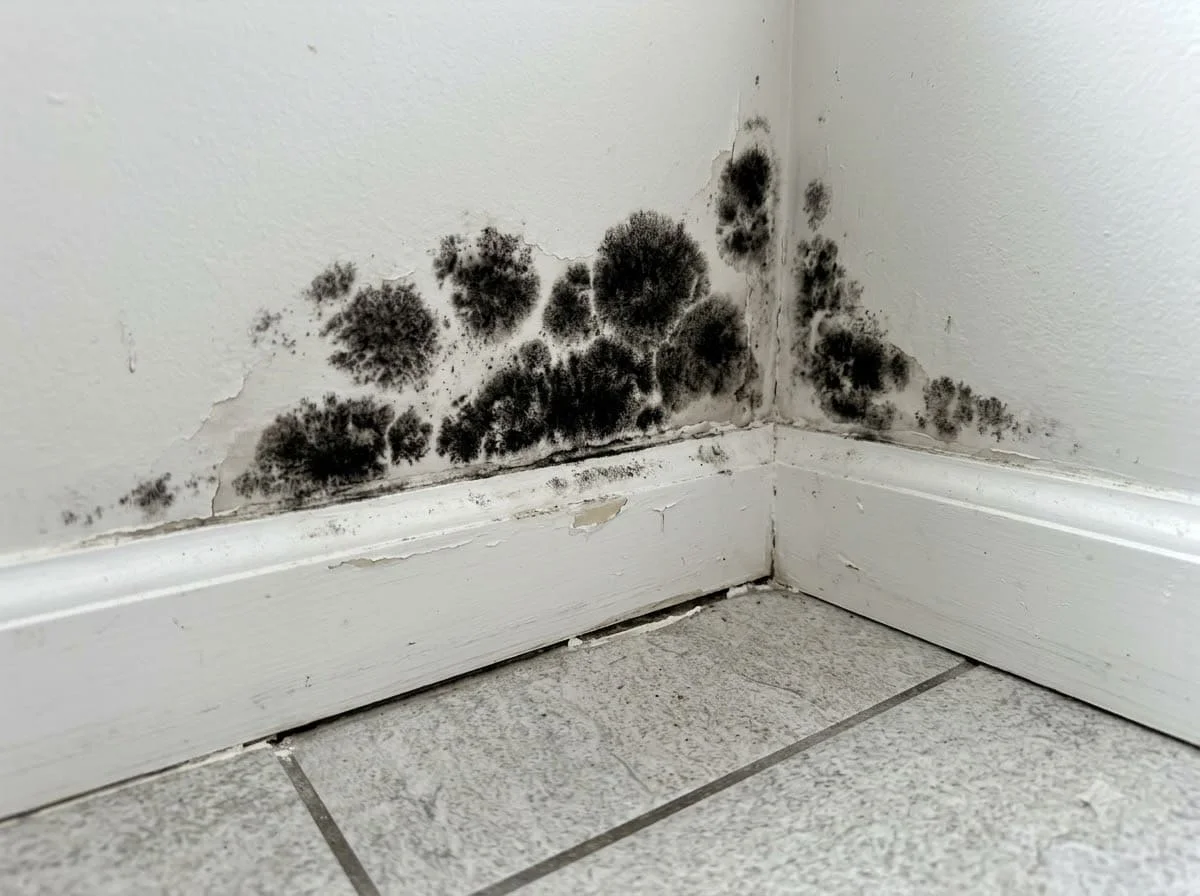
"Black mold" is the phrase that makes Arizona homeowners call somebody. It carries more alarm than any other term in this field, and a fair amount of that alarm has been manufactured by companies that benefit from it. The reality is more mundane and more useful to know.
Here is what black mold actually is, why it turns up in a desert climate, where it grows in Arizona homes, what the health picture honestly looks like, and where the line falls between a cleanup you can handle and one you should not.
What Is Black Mold?
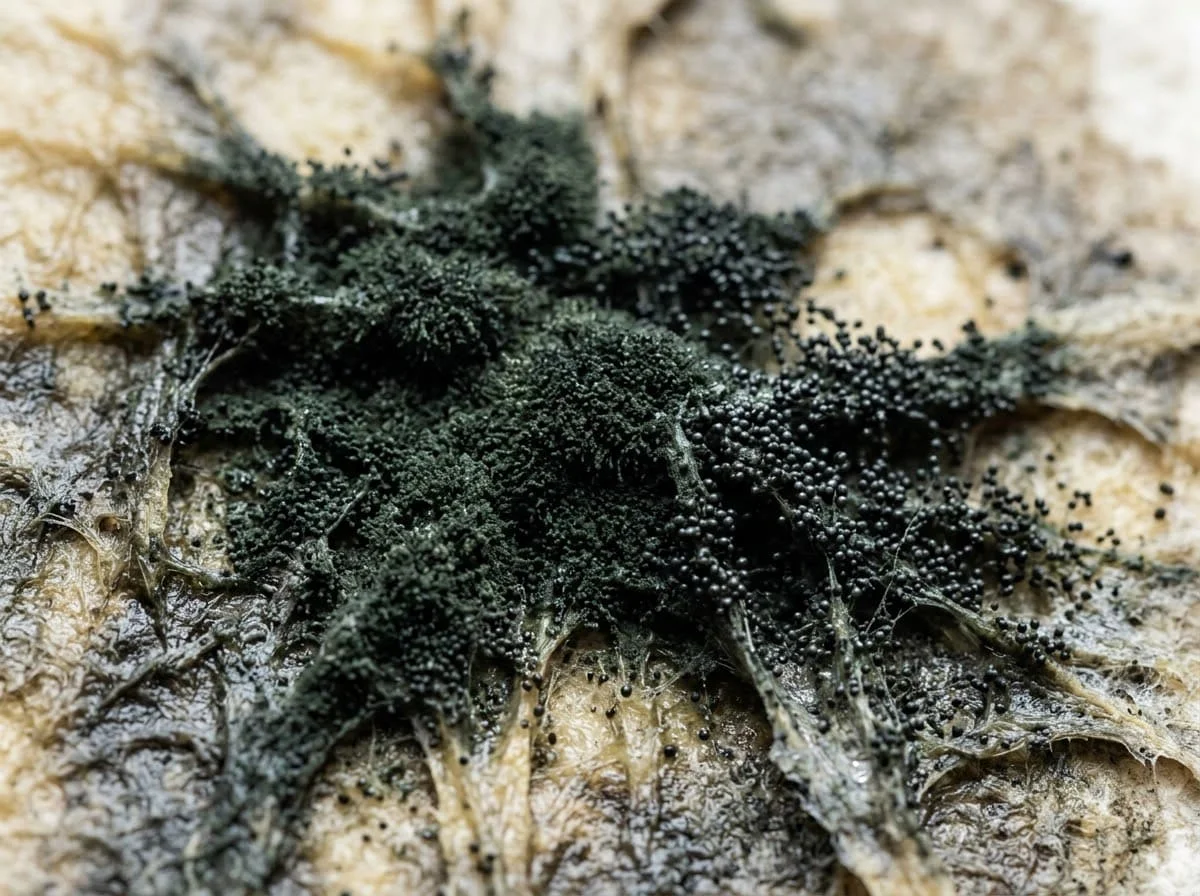 Close-up of dark greenish-black Stachybotrys mold colony growing on damp drywall
In technical usage, "black mold" means Stachybotrys chartarum, a greenish-black mold that requires sustained wet conditions and grows on high-cellulose material — drywall paper, cardboard, ceiling tile, wood, and lint. It needs material that has been genuinely wet for days or longer, not merely humid.
In everyday usage, "black mold" means any dark growth someone finds on a wall. Those two meanings are not close to the same thing. Cladosporium, one of the most common indoor molds anywhere, is frequently dark green or black. Aspergillus niger is black. Alternaria, typical around showers and windows, is dark olive. Any of these would be called black mold by a homeowner and by plenty of salespeople.
Nobody can identify Stachybotrys visually. Not a homeowner, not an inspector, not a remediation contractor. Species identification requires lab analysis of a physical sample. Anyone who looks at a wall and declares it toxic black mold on the spot is selling, not diagnosing.
Why species matters less than it sounds: the remediation approach does not change based on the lab result. Any substantial indoor colony needs the same response — find the water, contain the area, remove the affected material, dry the assembly, verify. Species identification is useful for documentation and for people with specific health sensitivities. It rarely changes the scope of work, which is why proper black mold removal is defined by the extent of the growth and the moisture source, not by the name on a lab report.
Why Black Mold Grows in Arizona
Stachybotrys is the fussiest of the common indoor molds about water. It needs a water activity level that other species do not require — in practical terms, material that has stayed wet for days rather than damp for hours. That requirement is exactly why its presence in an Arizona home is informative: it means there has been a sustained, ongoing moisture source, not a one-time spill.
The Arizona moisture sources that meet that standard are specific:
- Slow supply-line and drain leaks inside wall cavities, running undetected for weeks or months. This is the single most common origin.
- Water heater failures — a leaking tank in a closet or garage soaks drywall bottom plates and adjacent framing before anyone notices.
- Monsoon roof leaks that wet insulation and ceiling drywall, then get topped up by the next storm before anything has dried.
- AC condensate overflow from a clogged drain line, which delivers water continuously all summer.
- Flat roof ponding on older Phoenix and Tucson housing stock, where standing water works through seams over a full season.
The pattern differs by region. West Valley communities combine older housing with heavy evaporative cooler use and agricultural irrigation nearby — homeowners looking into mold removal in Waddell and surrounding areas are frequently dealing with a plumbing or swamp cooler leak that ran quietly through a full cooling season. In the Northeast Valley, hillside drainage and custom-home complexity change the picture; the moisture behind mold problems in Fountain Hills more often traces to storm runoff on sloped lots and to roof and deck details that older flat-lot construction never had to solve.
Where Black Mold Shows Up in Arizona Homes
Bathrooms and Kitchens
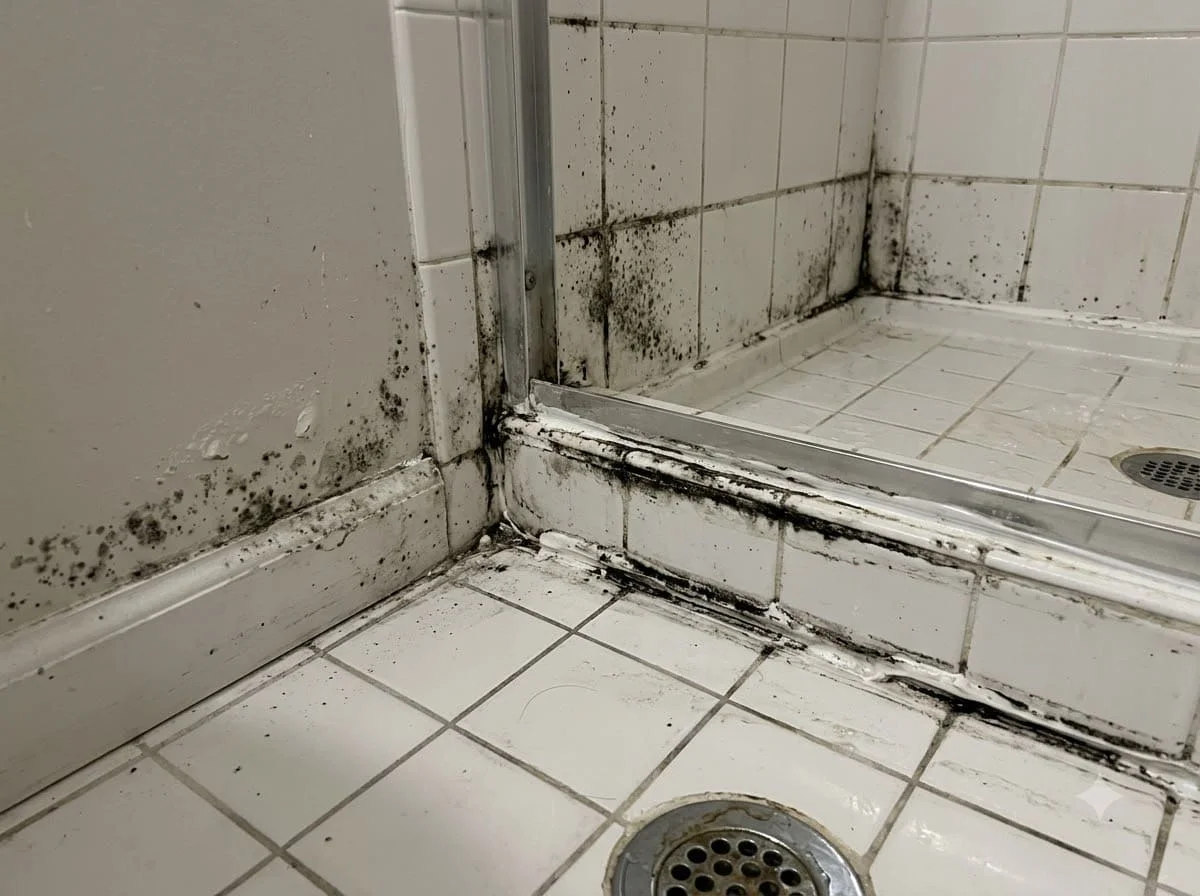 Dark mold growth along bathroom grout lines, caulk, and the base of a wall near a shower
Bathrooms are where homeowners find growth first, and usually where it is least serious. Dark spots on grout, caulk, and the ceiling above a shower are typically surface molds on non-porous material, cleanable and not structural. What they indicate is more important than what they are: the exhaust fan is undersized, not being run long enough, or — a common Arizona construction shortcut — vented into the attic rather than outdoors.
The serious version is behind the wall. A leaking shower pan, a failed toilet supply connection, or a drain leak under a vanity keeps framing and drywall wet continuously, and that is the condition Stachybotrys actually needs. The tell is a musty smell that persists after the visible surface growth has been cleaned. Kitchens follow the same logic: dishwasher supply lines, refrigerator ice-maker lines, and sink drain connections are all enclosed, all slow, and all rarely inspected.
Attics and Crawl Spaces
Arizona attics reach 140°F or more in summer, and heat accelerates growth wherever moisture is available. Three sources supply it: roof leaks wetting sheathing from above, air-conditioning ducts sweating and dripping onto insulation, and bathroom exhaust fans discharging humid air directly into the attic. Growth on roof sheathing can spread across a large area before anything is visible from inside the house.
Crawl spaces are less common in Arizona than in other states, but where they exist — older properties, hillside construction, some custom builds — they combine ground moisture, plumbing runs, and effectively zero air movement. That is close to ideal for Stachybotrys, and it grows undisturbed because nobody goes down there.
Behind Walls After Water Damage
This is where black mold most often lives in Arizona. A wall cavity that got wet and was never properly dried is dark, undisturbed, cellulose-rich, and — if the leak is ongoing — continuously wet. Every condition Stachybotrys requires, in one place.
The failure mode is almost always incomplete drying. Water damage gets addressed on the visible side, the carpet is dried, the drywall surface looks fine, and the interior of the cavity never gets below the moisture threshold. Six weeks later there is a smell. This is why a proper mold inspection with moisture mapping matters after any significant water event — thermal imaging and pin meters read what the surface does not show, and they find the wet cavity before it becomes a colony.
Health Risks of Black Mold Exposure
The honest version of this section is less dramatic than what most sites publish. Stachybotrys can produce mycotoxins under certain growth conditions, and that fact has been stretched a long way. The CDC's position is that a causal link between household black mold and severe conditions such as pulmonary hemorrhage or memory loss has not been established.
What is well supported:
- Respiratory irritation — coughing, wheezing, chest tightness, congestion
- Allergic response — sneezing, runny nose, itchy or watering eyes, skin irritation
- Asthma aggravation — more frequent and more severe attacks in people who already have asthma
- Upper respiratory symptoms in otherwise healthy people with sustained exposure
Certain groups warrant more caution: infants and young children, older adults, people with asthma or COPD, people who are immunocompromised, and anyone undergoing treatment that suppresses immune function. For those households, the threshold for professional handling should be lower than the general guidance below.
A practical signal: if symptoms consistently improve when someone leaves the house for a day or two and return within hours of coming back, that pattern is worth taking seriously — regardless of what species is eventually identified.
DIY Cleanup vs Professional Removal
The EPA's residential guidance uses roughly 10 square feet — a 3-by-3 patch — as the practical dividing line. It is a useful rule, but the material matters as much as the area.
| Situation | Reasonable approach |
|---|---|
| Under 10 sq ft, hard non-porous surface (tile, grout, finished wood), leak already fixed | DIY cleanup with detergent and water, N95 respirator, gloves, eye protection, good ventilation |
| Any porous material — drywall, insulation, carpet, ceiling tile | Professional removal; porous material cannot be cleaned and must be cut out |
| Over 10 sq ft, or spread across multiple areas | Professional remediation with containment |
| HVAC system or ductwork involved | Professional; the system will otherwise distribute spores house-wide |
| Sewage or flood water involved | Professional; contamination is not limited to mold |
| Growth returns after cleanup | Professional; the moisture source has not been found |
Two things never to do: do not paint over mold — coating it hides the growth while it continues underneath, and it destroys the evidence a later inspection needs. And do not dry-brush or sand a colony, which aerosolizes an enormous quantity of spores and turns a contained problem into a house-wide one.
How Professional Black Mold Removal Works
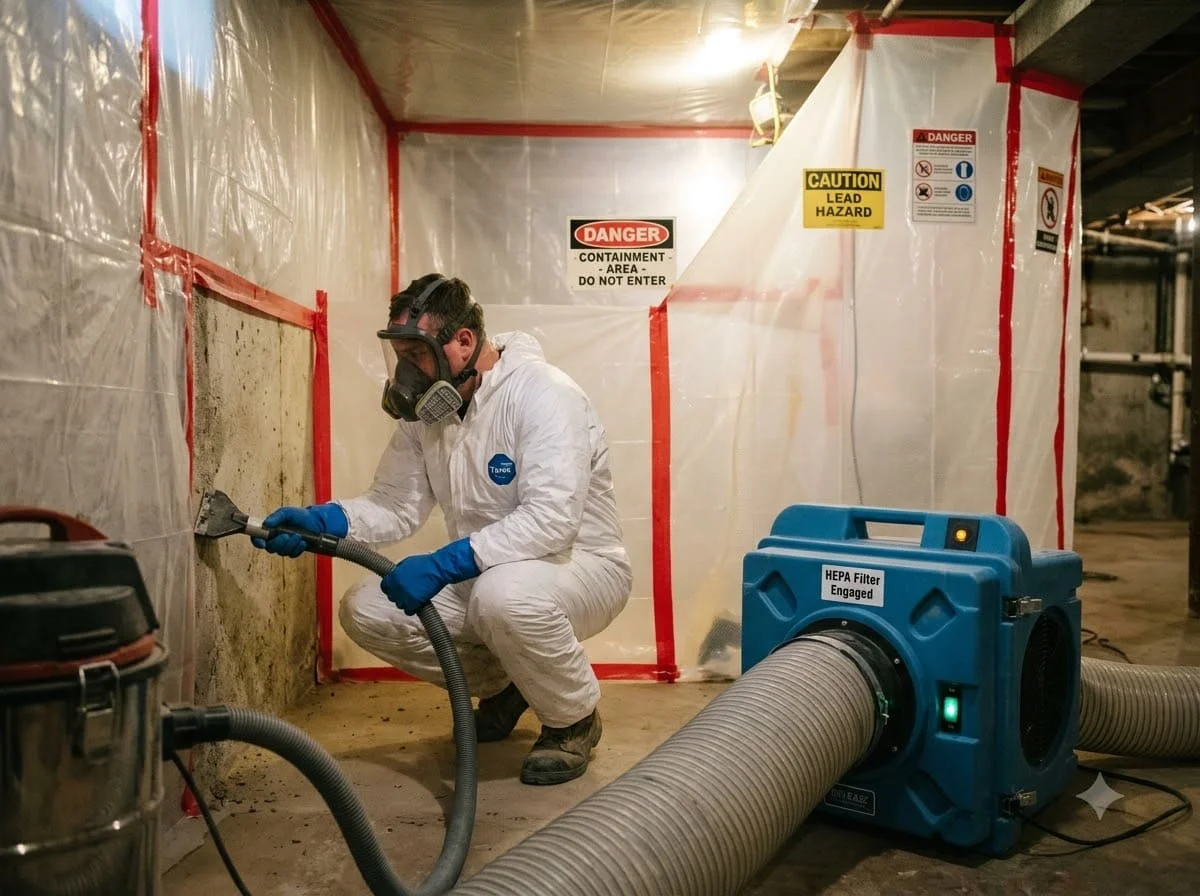 Remediation technician in protective equipment working inside a sealed plastic containment area with a HEPA air scrubber
A contractor working to the ANSI/IICRC S520 standard follows a recognizable sequence. Knowing it lets you read a quote and tell whether steps have been left out.
- Assessment and moisture mapping. Identify the water source, define the affected area with meters and thermal imaging, and document the scope before anything is removed.
- Containment. Seal the work area with polyethylene sheeting, close off HVAC registers, and establish negative air pressure so air flows into the containment and never out of it. This step is what separates real remediation from cleaning, and it is the step most often missing from a cheap quote.
- HEPA air filtration. Air scrubbers run throughout the work to capture airborne spores disturbed during removal.
- Removal. Porous material — drywall, insulation, carpet, pad — is cut out and bagged. Non-porous framing and hard surfaces are HEPA-vacuumed and cleaned rather than replaced.
- Antimicrobial treatment. Applied to remaining structural surfaces. Worth understanding: this is a finishing step, not the removal method. Treatment applied over material that was never physically removed is not remediation.
- Drying and moisture correction. Dehumidifiers and air movers bring the assembly back to normal moisture content, and the original water source is repaired. Skip this and the colony returns.
- Clearance testing. Post-remediation verification — ideally by an independent third party, not the company that did the work — confirms spore counts are back to normal before the containment comes down.
That last point is the one worth insisting on. A contractor who performs the remediation and also certifies their own work has an obvious conflict. The stronger arrangement is an independent inspector for testing and clearance, and a separate contractor for the removal itself.
Arizona Mold Pros is a directory rather than a remediation company — we compare the contractors who do this work on public ratings, licensing status, services, and Arizona experience. If you have found dark growth and want quotes from specialists in your area, see how black mold removal is handled and call for a free, no-obligation comparison.