The honest answer is: sometimes, and less than most homeowners expect. Standard Arizona homeowners policies were never designed to pay for mold remediation on its own — they cover mold as a byproduct of a covered water loss, subject to a cap that is often much smaller than the actual cost of fixing it.
Here is how that actually plays out — what gets covered, what typically does not, the sublimit most Arizona policies quietly carry, and what to document before you touch anything.
The Rule Insurers Actually Use: Sudden vs. Gradual
 Homeowner reviewing paperwork and documentation related to a water damage insurance claim
Every mold coverage decision in Arizona comes back to one distinction: was the water event sudden and accidental, or did it develop gradually over time? A supply line that bursts, a water heater tank that fails outright, or a roof that a monsoon storm tears open are treated as sudden. A slow drain leak under a cabinet that ran for months, or a roof that has seeped a little during every storm for two years, is treated as gradual — and gradual damage is exactly what most policies exclude as a maintenance issue the homeowner should have caught.
Mold coverage almost always follows whichever bucket the underlying water event falls into. If the water damage itself is covered, the mold that followed it usually is too, up to the policy's mold sublimit. If the water damage is excluded as gradual seepage, any mold that grew from it is excluded along with it.
Why this trips people up: a homeowner who notices a small stain and waits a few weeks to see if it gets worse has, without realizing it, turned a sudden event into something that looks gradual by the time a claim gets filed. Report water damage promptly — the delay itself can affect the outcome.
What's Typically Covered vs. Excluded
| Situation | Usually covered? |
|---|---|
| Burst supply line or water heater failure that caused mold | Yes, up to the mold sublimit |
| Monsoon rain that entered through a wind-damaged roof or window | Usually yes — wind damage is a named peril on most policies |
| Ground water or flash flooding entering from outside | No — requires separate flood insurance |
| A slow leak the homeowner knew about and did not fix | No — treated as a maintenance failure |
| Mold from long-term high humidity with no specific water event | No — not tied to a covered peril |
| Sewer or drain backup | Only with a separate water backup endorsement |
The Sublimit Most Homeowners Don't Know They Have
Even when a mold claim is approved, most Arizona policies cap what they'll pay for mold-specific remediation — separately from the broader water damage repair — somewhere in the $1,000 to $10,000 range per occurrence. That number is buried in the policy declarations page, not the summary your agent walks you through at renewal.
A small bathroom colony might fall entirely within that cap. A colony that has spread through wall cavities, attic sheathing, or HVAC ductwork routinely costs more than the sublimit to remediate properly, and the difference is the homeowner's responsibility. Some carriers offer a higher mold endorsement for an added premium — worth asking about directly if your home has had water intrusion before, sits in an older neighborhood with aging plumbing, or backs up to a wash.
Documenting a Claim the Right Way
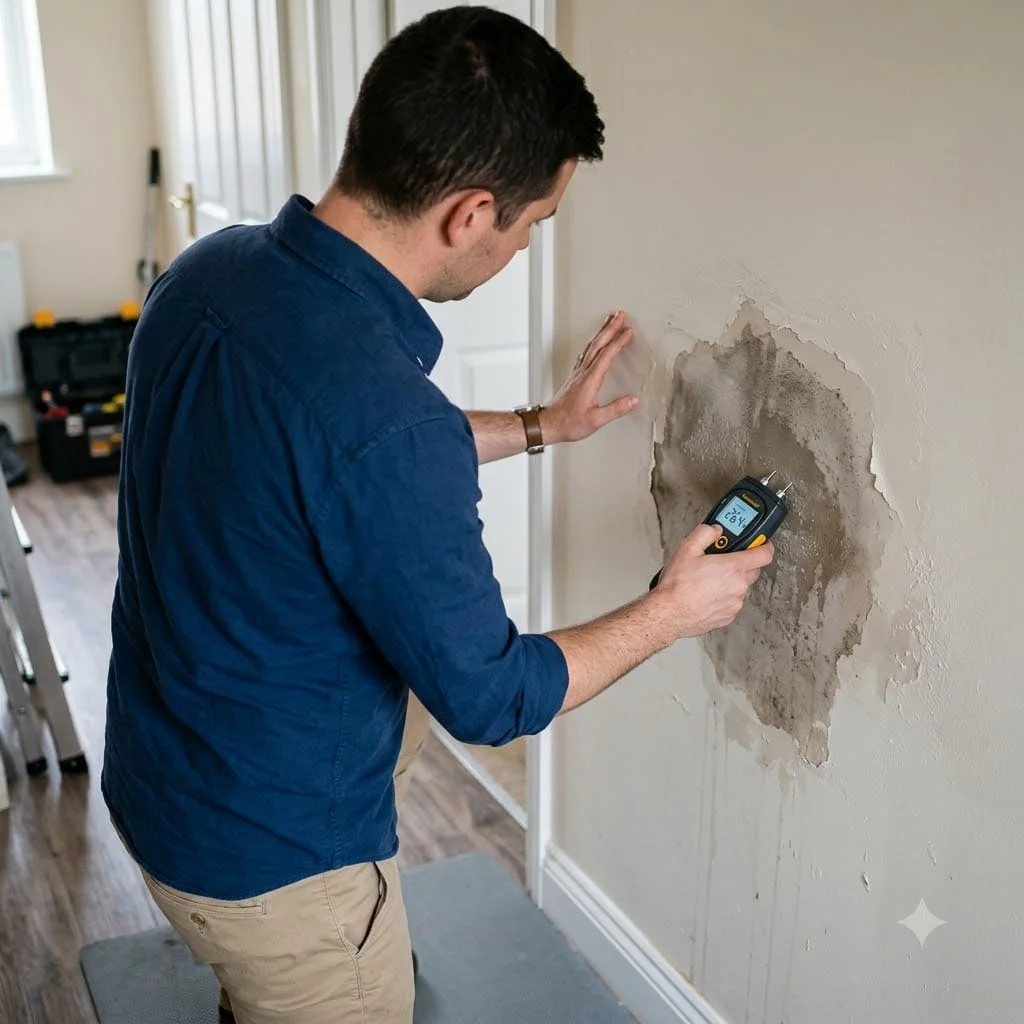 Person examining a damp wall with a moisture meter to document water damage for an insurance claim
- Photograph before you touch anything. Wide shots of the room, then close-ups of the growth, staining, and the failure point itself — the fitting, the water heater, the roof penetration.
- Note the timeline. When you discovered it, when you believe the water event happened, and when you reported it. The gap between discovery and reporting matters more than most homeowners expect.
- Get an independent inspection report. A documented mold inspection with moisture readings gives the adjuster something concrete to evaluate, rather than a verbal description of a smell.
- Call your carrier promptly and get a claim number the same week, not after you've tried to handle it yourself first.
- Keep every receipt — inspection fees, temporary equipment rental, any remediation work performed before the claim is fully resolved.
Whatever the claim decision, the remediation itself follows the same standard either way. Professional mold remediation means containment, HEPA filtration, physical removal of affected material, and a verified dry result — insurance coverage changes who pays for that work, not what the work has to be.
Where This Comes Up Most in Arizona
Claims cluster around a few predictable patterns. Aging supply lines under the 1996–2007 housing boom in Surprise are reaching the point where pinhole leaks and water heater failures are common enough to be almost routine. Older neighborhoods split across Peoria's Agua Fria and New River floodplain see a mix of both — plumbing-driven claims and genuine flood exposure that a standard policy will not touch. Reading a claim correctly usually starts with knowing which of those two categories your water event actually falls into — see our guide on what to do in the first 48 hours after monsoon flooding for the documentation steps that matter most in the moment.
Arizona Mold Pros is a directory, not an insurance company or a remediation contractor — we compare the specialists who perform inspections and remediation so you have an independent report to bring to your adjuster. Call for free, no-obligation quotes from contractors serving your area.