
A monsoon storm does its damage in twenty minutes. Mold takes a little longer — but not much. Common indoor molds can begin colonizing wet building material within 24 to 48 hours, and that clock starts the moment the material gets wet, not when you notice a stain. The gap between those two events is exactly where most Arizona homeowners lose the window to prevent a problem instead of remediating one.
This is a timeline, not a general water-damage guide — what to actually do in the hours right after a monsoon storm passes, where that rain tends to get in that people miss, and how to tell whether you are still inside the 48-hour window or already past it.
Why the First 48 Hours After a Monsoon Storm Matter
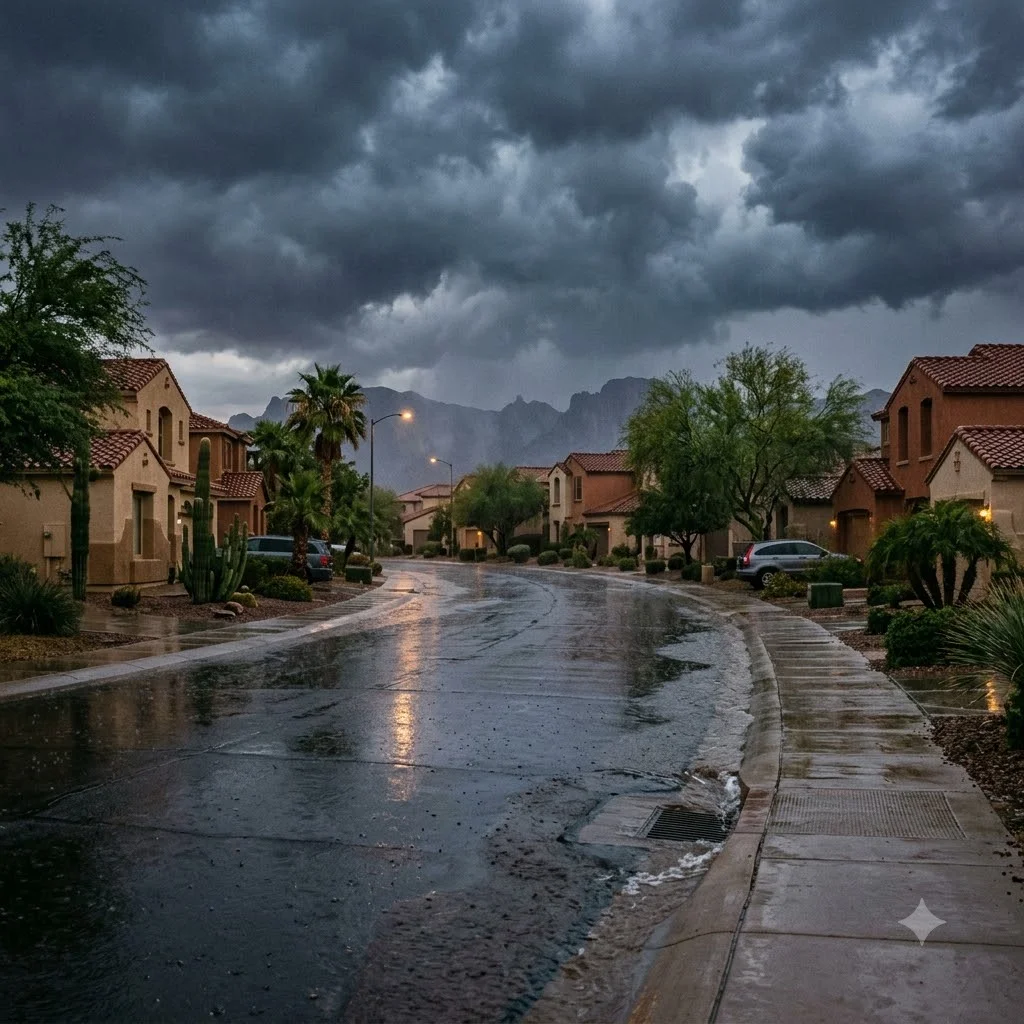 Flooded Arizona residential street with water pooling against home foundations during a monsoon storm
A monsoon microburst can drop close to an inch of rain in twenty minutes while driving it sideways at highway speed. That is a different load than the slow, steady rain most roofs and wall systems are actually built to shed. Water finds penetrations that would never leak in a normal storm — a roof-to-wall flashing detail, a window that sheds vertical rain fine, a chimney cricket that has never once needed to stop wind-driven water.
Once that water is inside a wall cavity, an attic, or under flooring, the outdoor dryness that defines an Arizona climate stops helping you. Desert air only dries what it can reach. A soaked stretch of insulation above a bedroom ceiling, or a wet bottom plate inside an exterior wall, sits in the dark at high heat with essentially no airflow — the exact condition mold needs, regardless of how dry it is outside.
The trap: the storm passes, the yard drains, and the house looks normal by dinner. Three weeks later there is a smell near a window that was not there before. The cavity behind that wall never dried — it just stopped being visible.
Where Monsoon Water Actually Gets In
Homeowners check the obvious spots — an active drip, a puddle on the floor — and miss the places monsoon rain actually enters. These are the repeat offenders:
- Windows and door thresholds. Wind-driven rain pushes water past weatherstripping and flashing that handles vertical rain without issue. A damp sill or a dark line at the base of a window frame the morning after a storm is a real signal, not a cosmetic one.
- Chimneys and skylights. Flashing details around any roof penetration are the first thing a sideways storm tests. A stain that appears only after monsoon storms — never after ordinary rain — almost always traces back to one of these.
- Flat and low-slope roof sections. Ponding water works into seams over the course of a storm rather than shedding immediately, which is why flat-roof leaks often show up hours after the rain has already stopped.
- Rooftop AC and swamp cooler penetrations. Every line set, duct penetration, and curb around rooftop equipment is a potential entry point, and older units develop gaps around their base over time that only leak under wind-driven rain.
- Garage doors and exterior grading. Ground water is a separate problem from roof leaks. Caliche soil sheds rain almost like pavement, so runoff moves fast and collects wherever grading allows — garage door thresholds and ground-level entries are the usual result.
Hour by Hour: What to Do After the Storm Passes
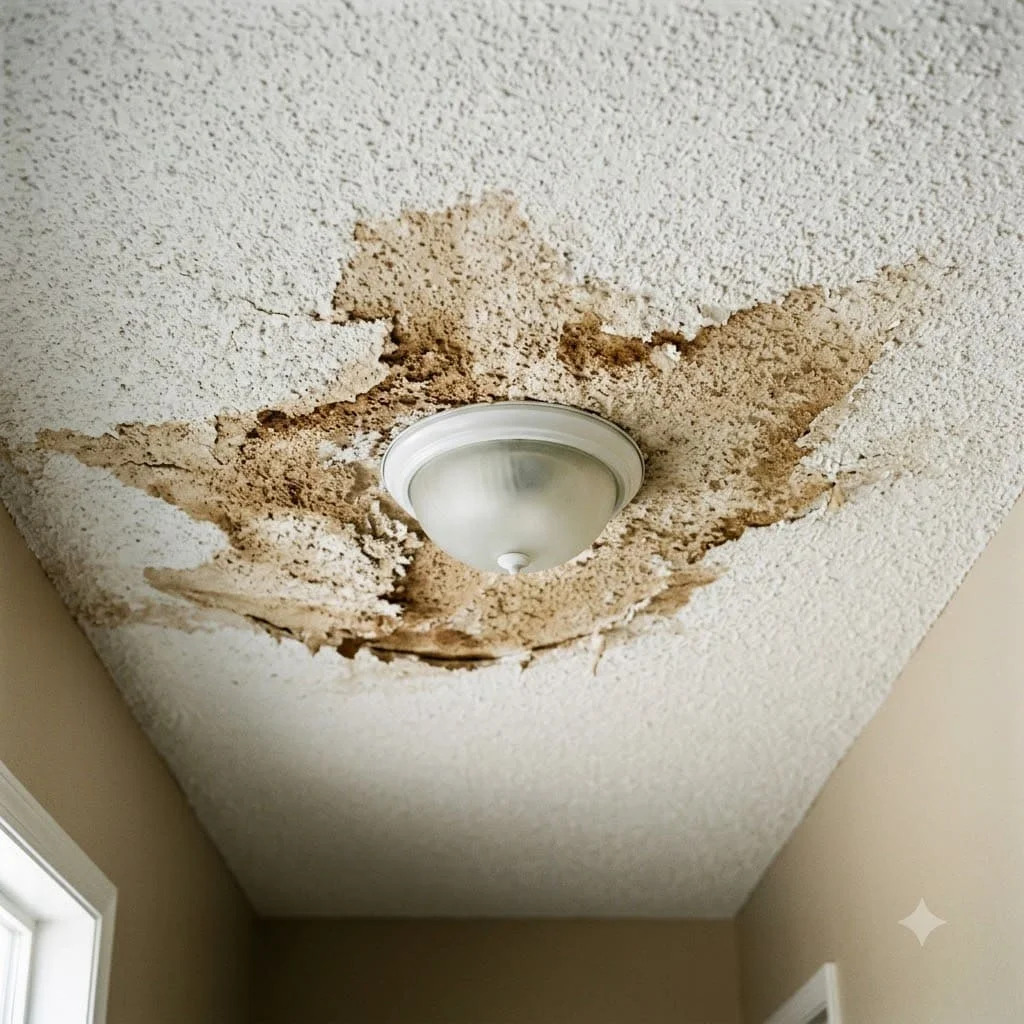 Water stain spreading across an interior ceiling near a light fixture after a monsoon storm
| Timeframe | What to do |
|---|---|
| While it's still raining | Contain, don't chase. Buckets under active drips, towels at door thresholds. Wait for the storm to pass before going on a roof or ladder. |
| First 2 hours after | Walk the interior perimeter — every window, exterior door, and ceiling. Check the attic if you can access it safely. Photograph anything damp before you touch it. |
| Hours 2–24 | Extract standing water, run the AC (not open windows — outdoor dew points are often still elevated), point fans at any wet surface, and pull back baseboards or trim wherever a wall felt damp. |
| Hours 24–48 | Re-check every spot you found damp on day one. Anything still damp, or newly showing a smell, has moved from a drying problem to a moisture-source problem that needs a professional look. |
| After 48 hours | Assume colonization may have started in anything that stayed wet. A moisture inspection at this point tells you whether you're looking at a cleanup or a remediation job. |
Signs the 48-Hour Window Has Already Closed
Sometimes the storm was two weeks ago and the smell just started. That does not mean nothing can be done — it means the material found is likely already colonized rather than just wet, which changes the response from drying to removal. Watch for:
- A musty or earthy smell that was not present before a specific storm
- Discoloration spreading along a ceiling seam, window frame, or baseboard
- Paint that has started bubbling or drywall that gives slightly under finger pressure
- A smell or symptom that improves when household members spend time away from the house
Any of these after a monsoon event is a reasonable trigger for a professional mold inspection. Thermal imaging and pin meters read what a wall's surface cannot show you, and finding a wet cavity now is a fraction of the cost of finding a colony in three months.
When to Call a Professional
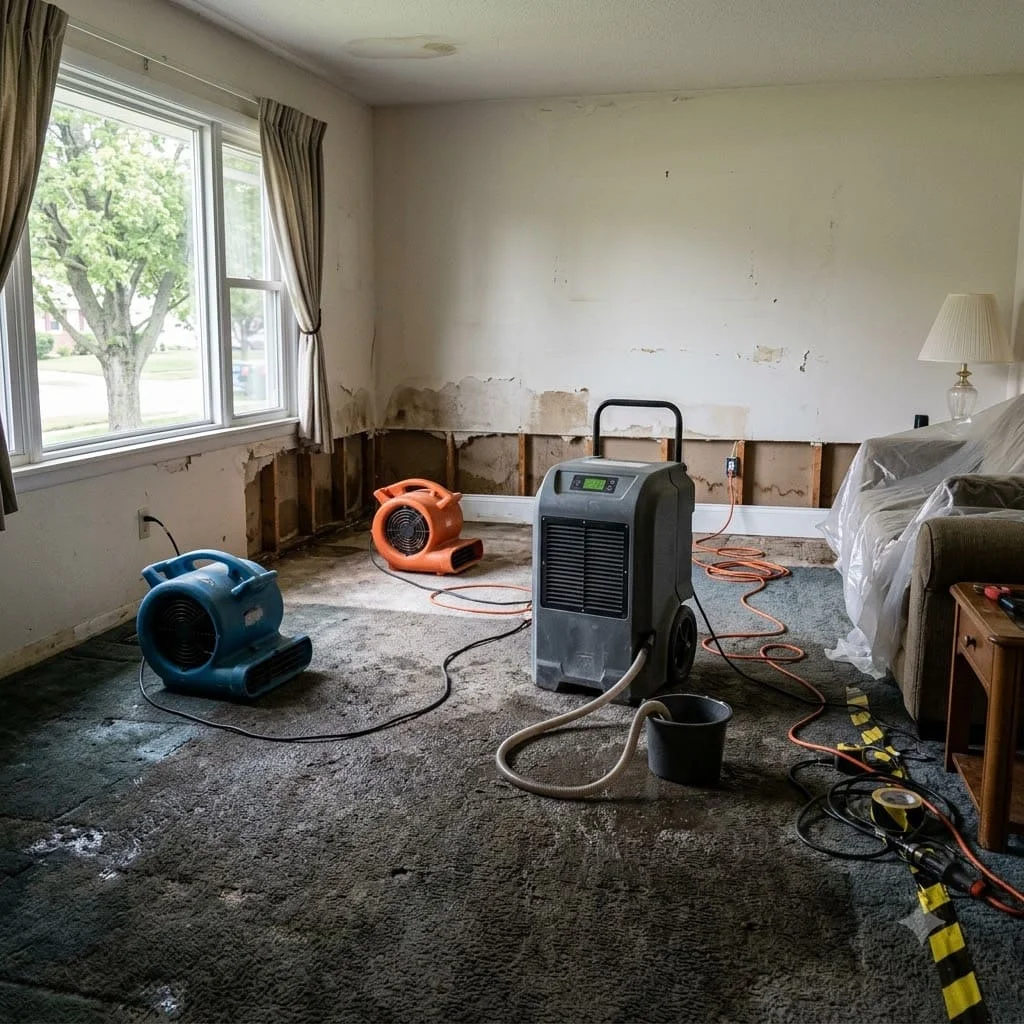 Air movers and a dehumidifier drying a room after monsoon water intrusion in an Arizona home
A household shop vac and box fans handle a small, contained spill on hard flooring caught within the first few hours. They do not handle water that reached drywall, insulation, or carpet pad — porous material holds moisture well past the point where it feels dry to the touch, and household fans move air without removing the moisture that air is carrying.
Professional water damage restoration pairs commercial dehumidifiers with air movers and verifies the result with daily moisture readings — rather than a fan running for a few days and a guess that it worked. That combination is what actually closes the mold window instead of just making the room feel dry.
This pattern repeats every monsoon season across the Valley. Newer housing stock in San Tan Valley sits on some of the lowest-lying ground in the East Valley corridor, where a hard storm sheets across farmland-turned-subdivisions faster than the drainage was designed for. Older plumbing and roofing in Tempe and the expansive clay soils under Chandler add their own version of the same problem — a storm finds whatever a house's weakest point already was.
Arizona Mold Pros is a directory, not a restoration company — we compare the contractors who do this work on public ratings, licensing and insurance status, and Arizona experience. If a recent storm got into your home, call for free, no-obligation quotes from specialists serving your area before the 48-hour window closes.