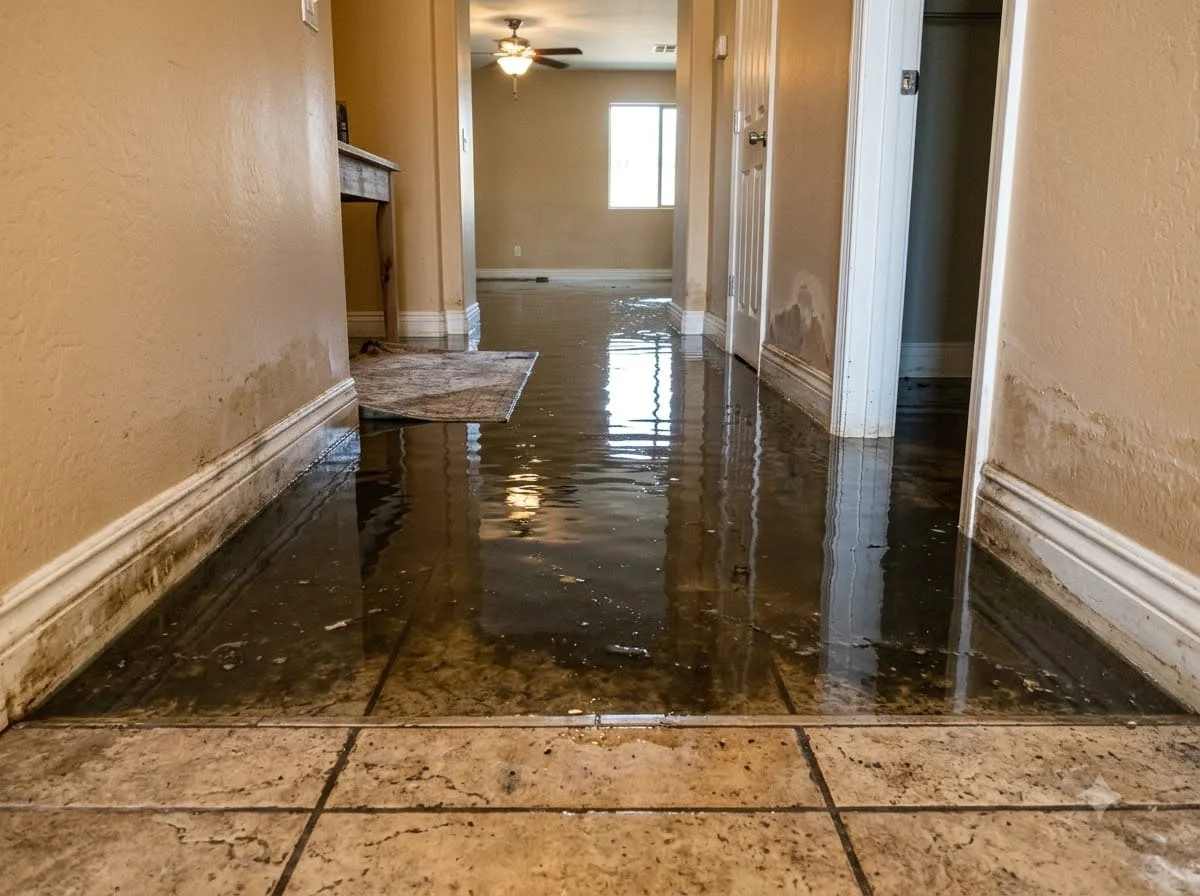
The first afternoon after water damage matters more than the following week. Mold can begin colonizing wet building material within 24 to 48 hours, and that window starts when the material got wet — not when you found it. What you do in the first few hours largely determines whether this becomes a drying job or a demolition job.
This is the order of operations: stop the water, document it, start drying, and know what not to tear out yet.
The 24-48 Hour Mold Window
Wet cellulose material — drywall, wood framing, subfloor, carpet pad, insulation — is food for common indoor molds as soon as it is saturated. Spores are already present in every Arizona home. Growth typically begins within 24 to 48 hours, and visible colonies commonly appear at day three to five. Once the material is colonized, drying alone no longer solves it; the affected material has to come out.
Arizona's low outdoor humidity genuinely helps here — dry air is a real advantage during structural drying, and it is why Arizona jobs often finish faster than the same job in a humid state. But that advantage only applies to surfaces air can reach. Inside a wall cavity, under a cabinet toe-kick, beneath laminate flooring, or in insulation, the desert air outside is irrelevant. Those pockets stay wet for weeks while the visible surfaces look and feel dry, which is precisely how homeowners conclude the problem resolved itself.
The trap: carpet dries, drywall surfaces feel fine, and the job looks done. Six weeks later there is a musty smell. The cavity behind the baseboard never got below the moisture threshold, and it has been growing the entire time.
Water category matters too. Clean water from a supply line gives you the full 24 to 48 hours. Gray water — dishwasher, washing machine, shower drain — is contaminated and degrades faster. Black water, meaning sewage or outdoor flood water, is a health hazard immediately and is never a DIY situation regardless of how small the area is.
Immediate Steps After Water Damage
Stop the Water Source
Nothing else matters until the water stops. For an interior plumbing failure, shut off the main — in most Arizona homes that valve is in the garage, near the water heater, or at the street-side meter box. Locate it now, before you need it. Individual fixture shutoffs under sinks and behind toilets handle smaller failures.
For a water heater failure, close the cold-water supply valve at the top of the tank and, if it is a gas unit, turn the gas control to off. For a roof leak during a monsoon storm, you are containing rather than stopping: buckets under active drips, and a small hole punched in a bulging ceiling to release trapped water in a controlled way rather than letting the whole section come down at once.
Kill power to affected areas at the breaker before entering standing water. If water has reached outlets, panels, or the furnace or air handler, do not enter — call the utility or an electrician.
Document Everything for Insurance
Do this before you move anything. Insurance outcomes in Arizona turn heavily on whether the loss reads as sudden and accidental versus long-term seepage, which most policies exclude as a maintenance issue.
- Photograph and video everything — wide shots of each room, then close-ups of damaged material and the failure point itself
- Capture the source — the burst fitting, the failed hose, the water heater, the ceiling stain — before any repair
- Note the timeline — when you discovered it, when the water stopped, when drying started
- Keep damaged items where safe, or photograph them thoroughly before disposal
- Save every receipt — equipment rental, a hotel stay, emergency plumbing
- Call your carrier promptly and get a claim number the same day
Standard Arizona homeowners policies generally cover sudden discharge and exclude external flooding, which requires separate flood insurance — a real consideration for homes in monsoon runoff paths and near washes.
Start Drying — But Don't Rip Out Walls Yet
Extract standing water as fast as you can: a wet vac, a submersible pump for deeper water, towels for the rest. Pull up soaked area rugs. Get furniture off wet carpet or put foil or blocks under the legs so finish does not bleed into it. Open interior doors and closets so air can reach every cavity, and run the air conditioning — refrigerated AC dehumidifies as it cools, which genuinely helps here.
Do not start demolition. It is tempting to cut out wet drywall immediately, and it works against you three ways: your insurer may need to see the damage intact to adjust the claim, a professional assessment defines a smaller and more accurate removal area than guesswork does, and opening a wall with a saw aerosolizes anything already growing inside it. Extract, dry, document — then let the scope be set by moisture readings.
One Arizona-specific caution: opening the house to outside air is a good instinct in dry weather and a bad one during a monsoon event, when outdoor dew points spike. Check conditions before opening windows — during a storm you are importing humidity, not removing it.
Common Causes of Water Damage in Arizona
Monsoon Storms and Flash Flooding
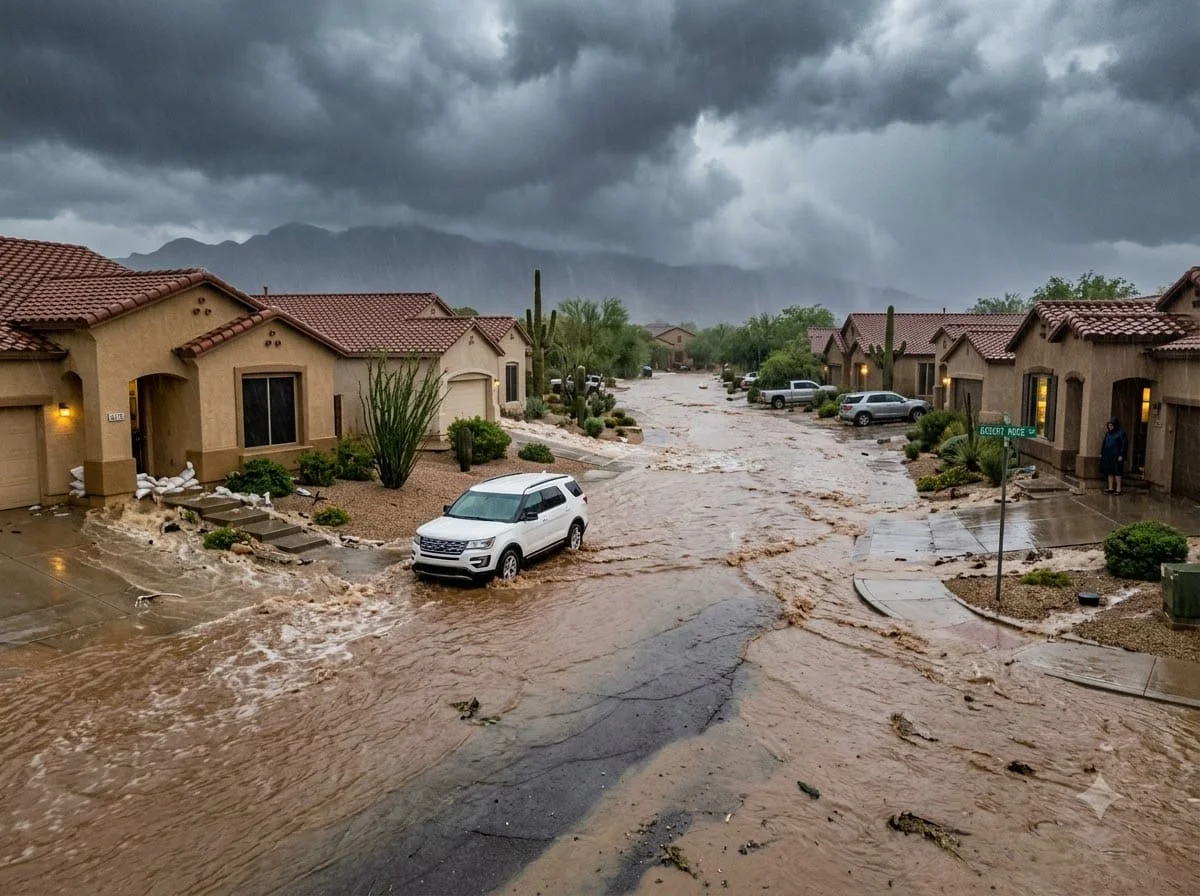 Flash flooding across an Arizona residential street during a monsoon storm with water approaching homes
Between mid-June and September, Arizona gets a large share of its annual rain in a few violent events. A microburst can drop an inch in twenty minutes while driving rain horizontally, which finds roof and wall penetrations that shed water perfectly well in a normal storm. Flat and low-slope roofs pond; tile roof underlayment fails under sideways rain; parapet flashing lets water track into wall cavities.
Then there is ground water. Sun-baked caliche soil sheds runoff almost like pavement, so water moves fast and collects wherever grading lets it. It enters through garage doors, ground-level thresholds, and window wells. Rural and low-density areas without engineered municipal storm drainage are especially exposed — properties around Rio Verde and the Northeast Valley depend heavily on natural drainage and lot grading, so a single storm that overwhelms a wash can put water where it has never been before. On the other side of the metro, the fast-growing West Valley has its own version: new development around Buckeye has changed how runoff moves across flat desert terrain, and flash flooding regularly reaches homes on ground that drained differently a decade ago.
Burst Pipes and Water Heater Failures
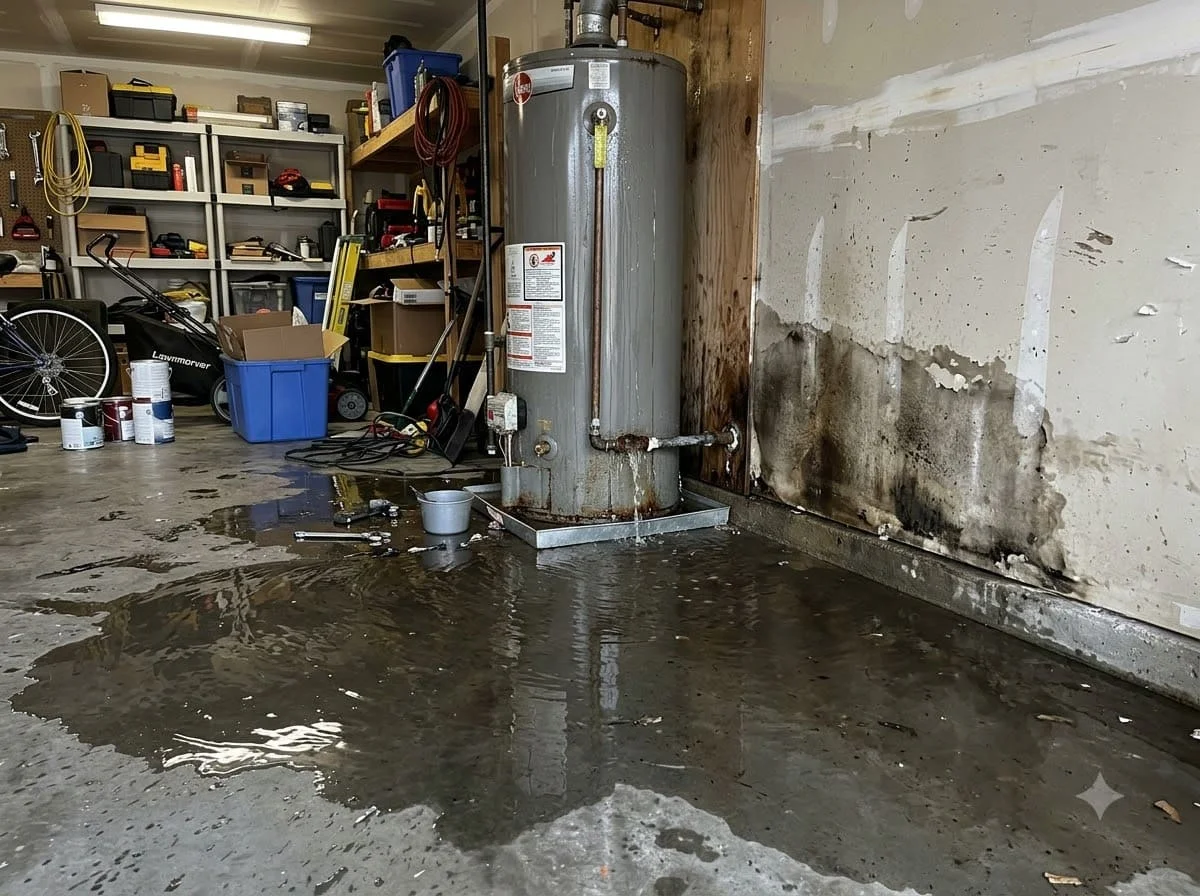 Leaking water heater in a garage with water pooling across the floor and soaking the adjacent wall
Interior plumbing failures cause more Arizona water damage than weather does, and they are worse because they run unattended. Arizona's hard water and, in some areas, aggressive soil chemistry shorten the life of galvanized and copper supply lines, producing pinhole leaks that run inside wall cavities for weeks.
Water heaters are the standout. Tanks last roughly 8 to 12 years, and Arizona's mineral content pushes toward the low end of that. When one fails it releases 40 to 80 gallons at once — and because most Arizona heaters sit in a garage or an interior closet rather than a basement, that water goes straight into adjacent living space. Know your heater's age, and if it is past ten years, a drain pan plumbed to a drain is cheap insurance. Braided stainless washing machine hoses are the same logic at a fraction of the cost.
Appliance Leaks and AC Condensation
The slow leaks do the most damage precisely because they are slow. Refrigerator ice-maker lines, dishwasher supply connections, and under-sink shutoffs all sit enclosed and unwatched, releasing small amounts of water continuously. By the time warped flooring or a cabinet stain shows up, the material behind it has been wet for months.
Air conditioning is a distinctly Arizona contributor. A clogged condensate drain line backs up into the pan and overflows — and because AC runs nearly continuously from May through September, that overflow is not one event but a steady daily supply. Attic air handlers make it worse: the water lands on insulation above ceiling drywall and nothing shows until a stain appears. Clearing the condensate line at the start of cooling season prevents a large share of Arizona's summer water damage.
When Water Damage Becomes a Mold Problem
Watch the days after. If any of these show up in the first week or two, the assembly did not dry:
- A musty or earthy smell that persists after surfaces are dry — the most reliable early signal
- Discoloration or staining spreading on drywall, baseboards, or ceilings
- Bubbling paint, peeling wallpaper, or soft drywall that gives under finger pressure
- Cupping, warping, or lifting flooring weeks after the event
- Visible growth at baseboards, in corners, or behind furniture placed against an affected wall
- Symptoms that improve when household members leave for a day or two
At that point drying is no longer the answer — colonized material has to be removed. Professional mold remediation means containment, negative air pressure, HEPA filtration, physical removal of porous material, and verification, in that order. Trying to dry out material that is already growing simply postpones the same work at a larger scope.
After any significant water event, a follow-up moisture inspection two to three weeks later is worth the cost even when everything looks fine. Thermal imaging and pin meters read wall cavities and subfloor that the surface does not reveal, and finding a wet cavity at week three is a fraction of the cost of finding a colony at month three.
How Professional Water Damage Restoration Works
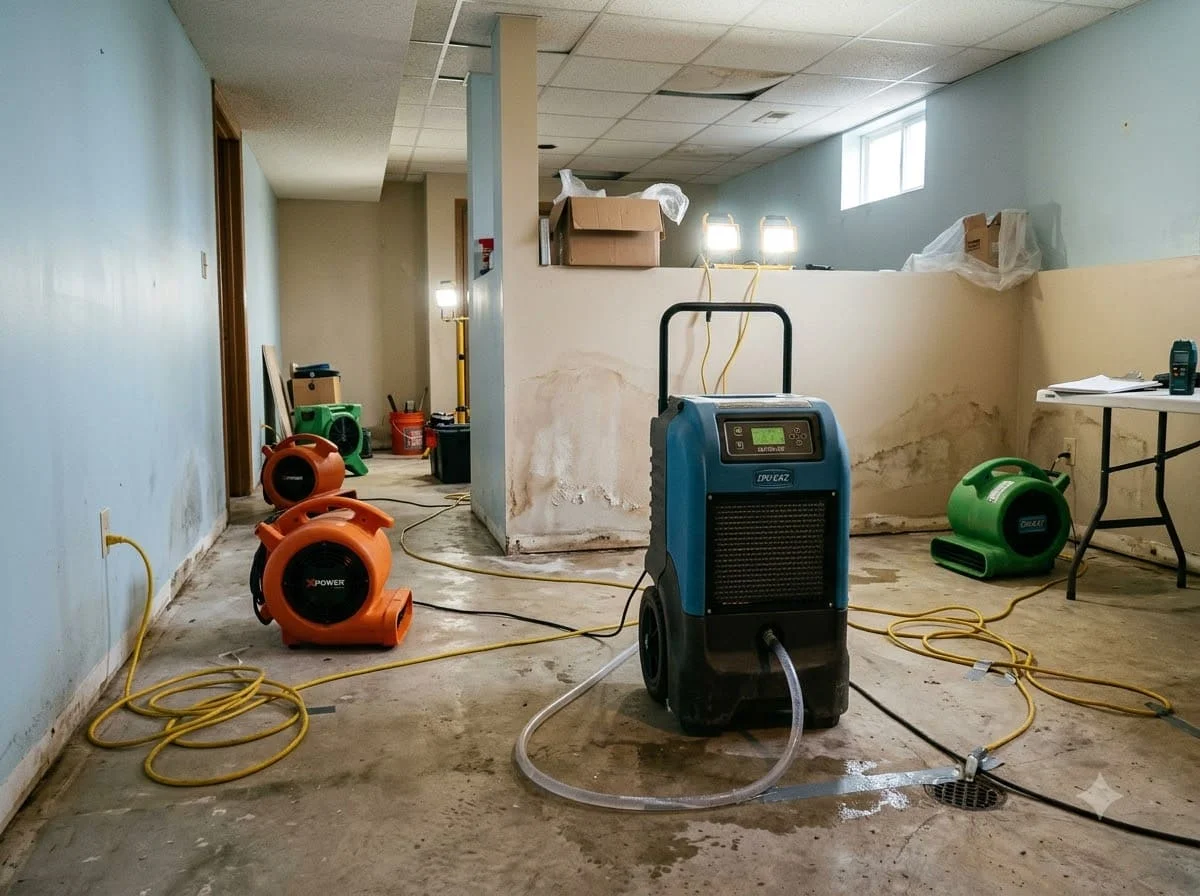 Air movers and a commercial dehumidifier running during structural drying in a water-damaged Arizona home
A contractor working to the IICRC S500 standard follows a defined sequence. Knowing it lets you evaluate a quote.
- Inspection and water categorization. Classify the water (clean, gray, or black), map the affected area with moisture meters and thermal imaging, and establish the drying goal for each material.
- Extraction. Truck-mounted or portable units pull standing water and draw water out of carpet and pad — far more effective than surface drying, and the step that most shortens the whole timeline.
- Controlled demolition, only where needed. Non-salvageable material — wet carpet pad, saturated insulation, drywall below the wet line — is removed. Scope is set by meter readings, not by eye.
- Structural drying. Air movers create evaporation while commercial dehumidifiers remove that moisture from the air. Both are required; air movement without dehumidification just relocates the water.
- Daily moisture monitoring. Readings logged each day against a dry standard, with equipment repositioned as materials respond. This documentation is also what supports the insurance claim.
- Antimicrobial application. Preventive treatment on affected surfaces to inhibit growth during the drying window.
- Verification and repair. Confirmed dry readings across all materials before reconstruction begins — drywall, flooring, paint, trim.
The step to ask about specifically is daily moisture logging. A restoration company that sets equipment and returns in four days to collect it has not verified anything. Documented daily readings are the difference between a job that is finished and a job that merely looks finished.
Arizona Mold Pros is a directory, not a restoration contractor — we compare the companies that do this work on public ratings, licensing and insurance status, response time, and Arizona experience. If water is in your home now, see what restoration involves and call for free, no-obligation quotes from contractors serving your area.