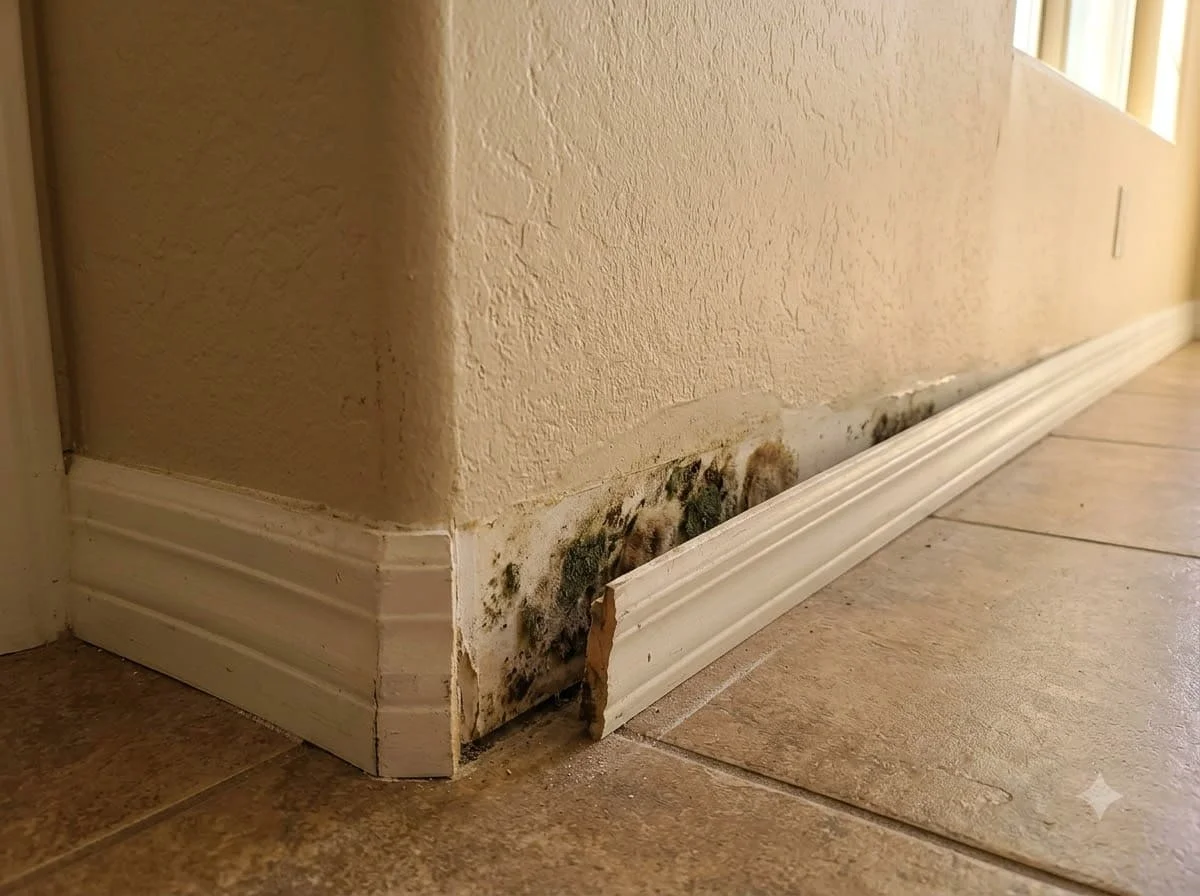
Ask most people whether mold is a problem in Arizona and you will get some version of the same answer: it is a desert, so it cannot be. That assumption is doing real damage to Arizona homes. Mold does not need a humid climate — it needs water, a food source, and time, and Arizona homes supply all three more often than their owners realize.
What follows is where that moisture actually comes from in Arizona, the places it tends to collect, and how to tell the difference between a patch you can wipe down yourself and a problem that needs opening a wall.
Arizona's Hidden Moisture Problem
Mold is a water problem before it is anything else. Spores are already present in every building in Arizona — they blow in through open doors, ride in on clothing, and settle in dust. They are inert and harmless in that state. What changes is whether they land on something wet enough, long enough, to germinate.
The threshold is lower than most homeowners expect. Common indoor molds begin colonizing damp cellulose material — drywall paper, wood framing, cardboard stored in a garage — within 24 to 48 hours. Sustained indoor relative humidity above about 60 percent is enough on its own, with no leak at all, to support growth on cool surfaces where moisture condenses.
The desert paradox: Arizona's outdoor dryness is exactly why indoor moisture goes unnoticed. In a humid climate, homeowners expect condensation and watch for it. In Phoenix, a damp spot under a sink reads as unremarkable — right up until a wall is opened and the framing behind it is black.
There is a second, less obvious factor. Arizona's extreme temperature differential drives condensation inside building assemblies. When it is 112°F outside and 76°F inside, any cool surface in contact with hot humid air becomes a condensation point. Air-conditioning ductwork running through a 140°F attic is the clearest example, and it is a common origin point for growth that only becomes visible when a ceiling stain appears months later.
By the time growth is visible, the moisture has usually been present for a while. That is why effective mold remediation always starts by finding and correcting the water source. Removing visible growth without fixing what fed it guarantees the colony returns, usually in the same spot within a season.
Top Causes of Mold in Arizona Homes
Four moisture sources account for the large majority of mold problems in Arizona homes. Each one behaves differently, and each leaves a different signature.
Monsoon Season Flooding and Roof Leaks
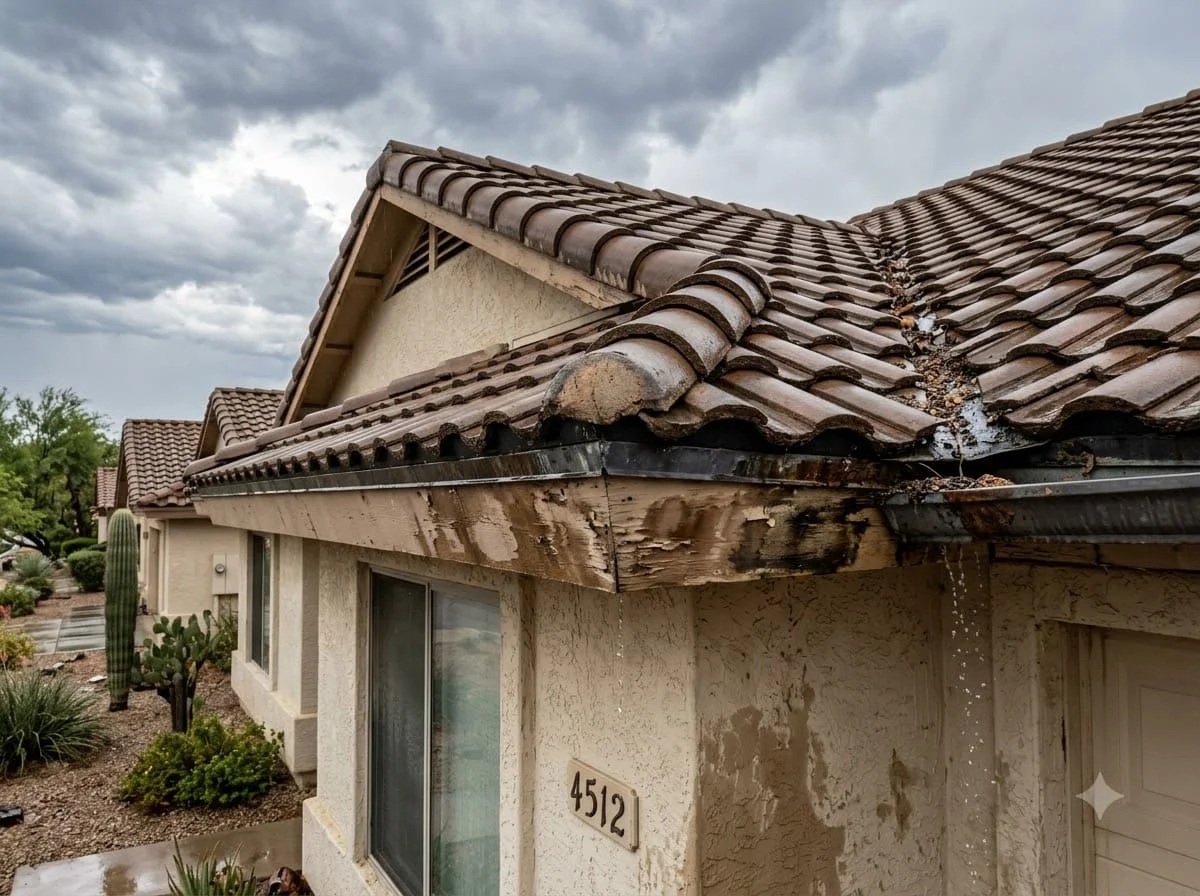 Water staining and damage on the roof and eaves of an Arizona home after a monsoon storm
From roughly mid-June through September, Arizona's monsoon delivers a year's worth of rain in a handful of violent events. A microburst can drop an inch of rain in twenty minutes while driving it horizontally at 60 miles per hour. Roof assemblies designed for water falling straight down do not always handle that.
Flat and low-slope roofs — common across older Phoenix and Tucson neighborhoods — are especially exposed. Ponding water finds seams, aging parapet flashing lets water track into wall cavities, and a leak that only appears during sideways rain is easy to dismiss as a one-time event. Tile roofs have their own version: the underlayment does the actual waterproofing, and when it degrades, water passes under intact-looking tile and into the deck.
The other monsoon problem is ground water. Sun-baked caliche soil sheds water almost like pavement rather than absorbing it, so runoff moves fast and pools against foundations. Homes in the fast-growing Southeast Valley see this pattern regularly — the drainage patterns behind many mold problems in Queen Creek trace back to storm runoff crossing former farmland that no longer drains the way the original grading assumed.
Swamp Cooler and HVAC Condensation
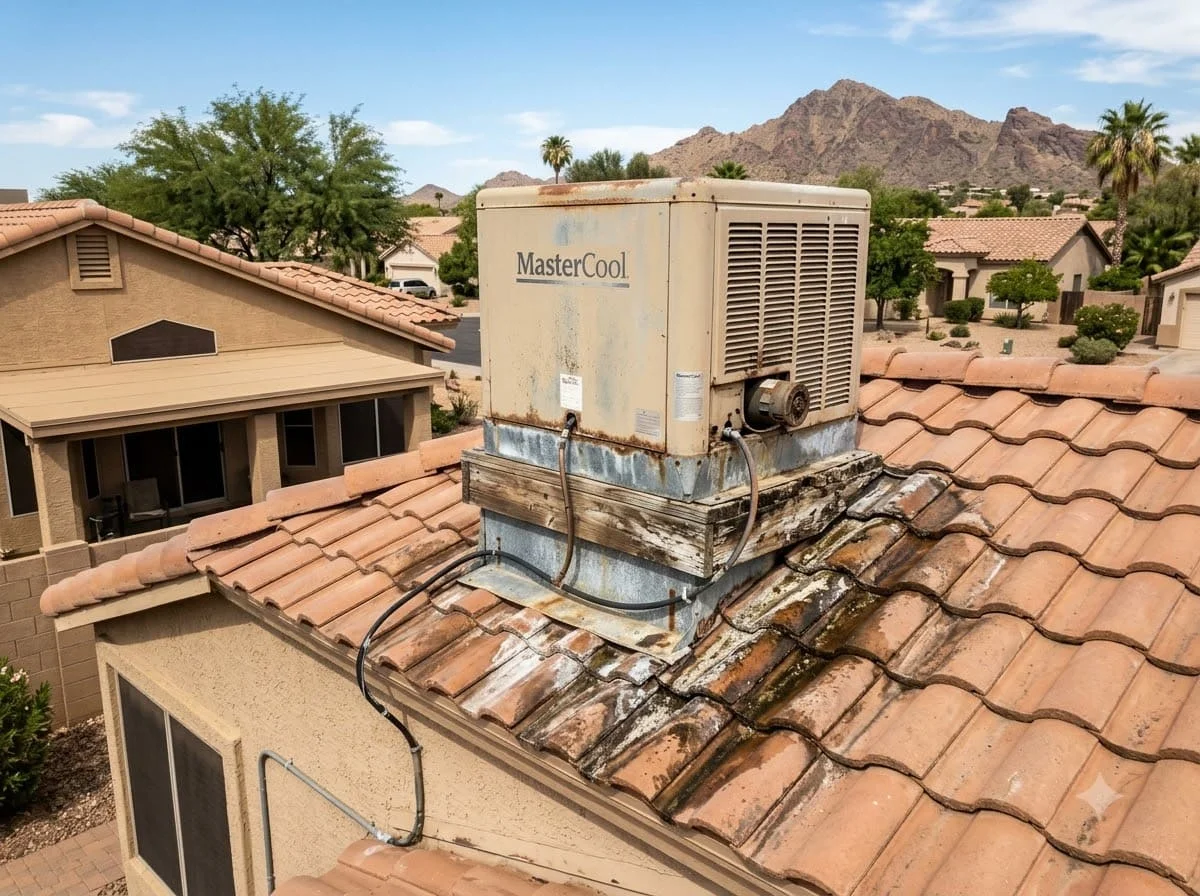 Rooftop evaporative swamp cooler unit on an Arizona home with visible moisture staining
An evaporative cooler cools by pulling outside air through saturated pads. It works beautifully in dry heat, and it works by deliberately raising indoor humidity. That is a reasonable trade in May. In August, when monsoon moisture has already pushed dew points up, a swamp cooler can hold indoor humidity high enough to support growth on any cool surface in the house.
The units themselves are a second problem. Pads that stay wet between uses, standing water in a reservoir, and ducting that sweats where it passes through hot attic space all create localized wet spots. Refrigerated air conditioning avoids the humidity issue but introduces its own: condensate drain pans that overflow when the line clogs, and cold supply ducts sweating in hot attics.
That attic ductwork problem is worth singling out. A sweating duct drips onto insulation, the insulation holds the water against the ceiling drywall, and nothing is visible from inside the house until a stain appears. It is one of the most common reasons Arizona homeowners end up needing attic mold removal despite never having had a roof leak at all.
Tight Construction Trapping Moisture
Homes built in Arizona since the early 2000s are dramatically better sealed than their 1970s counterparts, which is excellent for cooling bills and a genuine complication for moisture. An older house leaked air constantly, and that unintentional ventilation dried out small amounts of moisture before they mattered. A modern, tightly sealed envelope does not. Whatever water gets in stays in.
Newer construction across the Southeast Valley shows this pattern clearly — the moisture issues behind mold in Higley homes more often involve trapped humidity in a sealed envelope than the outright roof failures typical of older housing stock. Stucco over foam sheathing compounds it, because stucco absorbs water and holds it against the assembly, and any gap at a window flange or pipe penetration becomes an entry point with no easy drying path.
Irrigation and Pool Moisture Near Foundations
Landscape irrigation is a quiet, continuous moisture source that runs on a timer year round. Drip emitters placed too close to the foundation, spray heads that hit stucco daily, and broken lines that run underground for weeks all put water where the house does not want it. Because it is scheduled and normal, nobody investigates.
Pools add to it. Splash-out, deck drainage sloped toward rather than away from the house, and equipment leaks near an exterior wall all keep soil saturated at the foundation. In slab-on-grade construction — the standard across the Phoenix and Tucson metros — that moisture can wick up through the slab and into flooring, baseboards, and the bottom plate of framing.
- Keep drip emitters at least 18 inches from the foundation
- Aim spray heads away from stucco and never at the house
- Check your water bill for unexplained increases — often the first sign of an underground irrigation break
- Verify grading slopes away from the house, especially after landscaping work
Where Mold Hides in Arizona Homes
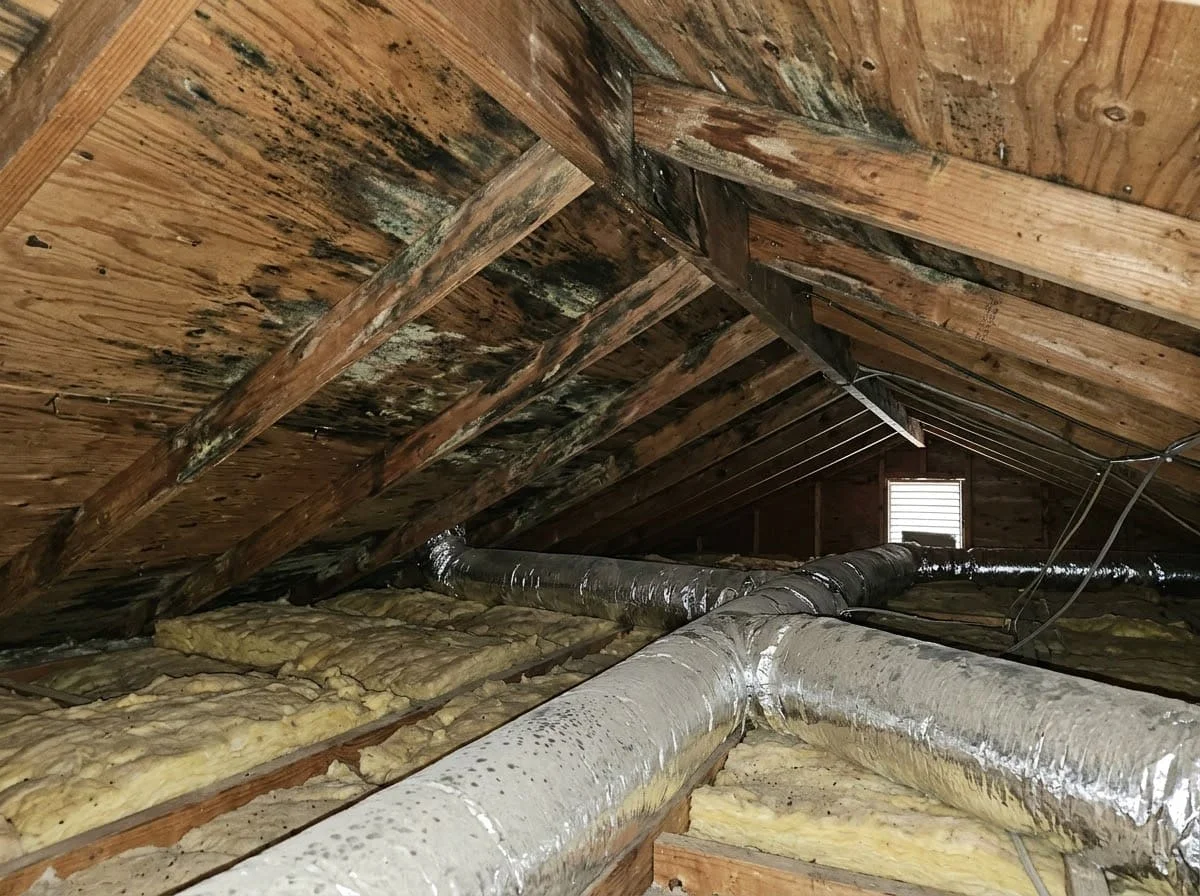 Mold growth on attic roof sheathing and rafters above insulation in an Arizona home
Arizona mold is usually hidden mold. The visible bathroom-ceiling variety is the exception; most colonies grow in places nobody looks until there is a reason to.
- Attics. Sweating supply ducts, bath fans venting into the attic instead of outdoors, and roof leaks that wet sheathing from above. Summer attic temperatures accelerate everything.
- Crawl spaces. Less common in Arizona than elsewhere, but where they exist, ground moisture and plumbing leaks collect with almost no air movement.
- Behind walls near plumbing. Supply lines, drain connections, and water heater pans. A pinhole leak in a wall cavity can run for months and only announce itself as a musty smell.
- Under sinks and behind appliances. Kitchen and bath cabinets, dishwasher supply lines, refrigerator ice-maker lines, and washing machine hoses — all enclosed, all rarely inspected.
- Around AC ducts and air handlers. Condensate pans, drain lines, and the insulation immediately around any cold surface in a hot space.
- Under flooring. Slab moisture trapped beneath vinyl, laminate, or tile, especially where a slow leak has been feeding it.
The reliable warning sign in all of these is smell. A persistent musty or earthy odor in an enclosed space — a closet, a bathroom, a hall near an air return — almost always means moisture is feeding something out of sight. Trust the smell even when there is nothing to see.
What to Do If You Suspect Mold
Start with the water. Whatever you do about the growth itself, it will come back unless the moisture source is found and corrected. That is the single most common reason homeowners pay for the same remediation twice.
For the cleanup itself, the EPA's guidance for homes uses roughly 10 square feet — about a 3-by-3 patch — as the practical dividing line. Below that threshold, on a hard non-porous surface like tile or finished wood, with the leak already fixed, a homeowner cleanup with detergent, water, and proper ventilation is reasonable. Wear an N95, gloves, and eye protection, and do not dry-brush growth, which sends spores airborne.
Call a professional when: the affected area exceeds about 10 square feet; the material is porous (drywall, insulation, carpet) and would need to be cut out; the HVAC system is involved; the water was sewage or flood water; growth keeps returning after cleanup; or anyone in the household has asthma, a compromised immune system, or symptoms that ease when they leave the house.
When you are past that line — or you smell something and cannot find it — the right first step is a professional mold inspection. A qualified inspector maps moisture with meters and thermal imaging, identifies the source, and documents the extent of the problem before anyone starts removing material. That report is what turns a vague worry into a defined scope of work, and it is what keeps a remediation quote honest.
One structural note worth knowing: the inspector and the remediation contractor ideally should not be the same company. A contractor who both diagnoses the problem and bills for solving it has an obvious incentive to find more of it. Arizona Mold Pros is a directory, not a remediation company — what we do is compare the contractors who perform this work so you can choose one with something to go on. Call for free, no-obligation quotes from specialists serving your part of the state.